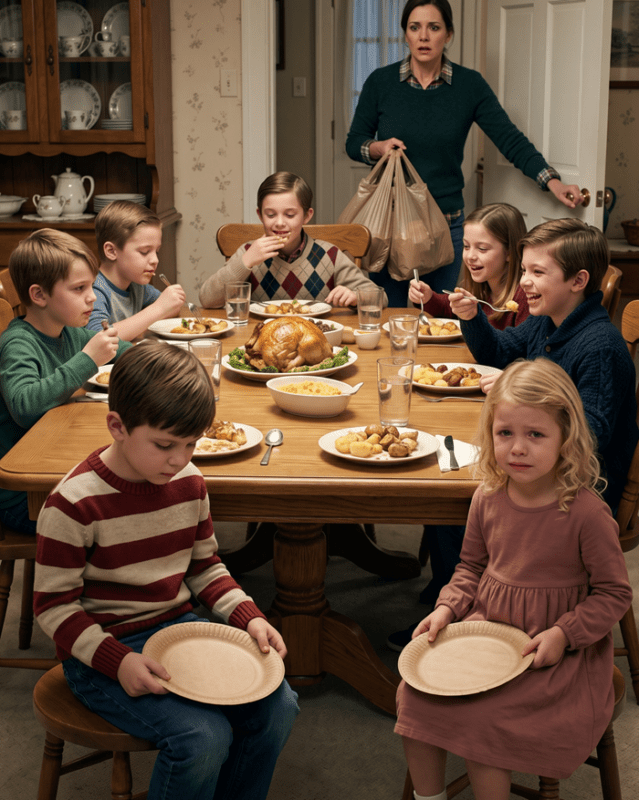


I Sent Money Home Every Month for My Sister’s Care—Then I Found Her …..
Every month, I sent money to my parents for one reason: to make sure my younger sister, Sophie, had the care and freedom she deserved.
On paper, that money paid for an aide, therapy, transportation, and the college course she had dreamed about for years.
In reality, I found Sophie on her knees in a utility hallway, scrubbing the floor with raw hands. When I moved her wheelchair within reach, she looked at me in terror and whispered, “Please hurry. If they see you helping me, they will be angry.” I did not argue with my parents. I took my sister and left. Hours later, I opened our grandmother’s trust agreement and discovered a clause that could cost my parents everything they believed they owned.
I Sent Money Home Every Month for My Sister’s Care—Then I Found Her — The Room Behind the Kitchen
My father was standing in the foyer, adjusting the knot of his silver tie beneath the chandelier.
“The girl is in the back,” he said when I asked where Sophie was. He did not say my sister’s name. He said it as if he were pointing out a misplaced piece of furniture.
The house was already dressed for the evening. White flowers stood in tall glass vases. A caterer hurried between the kitchen and the dining room. On the mantel, a polished crystal plaque waited beneath a spotlight. My parents were due to receive the town’s Exemplary Caregiver Award in less than two hours.
They had expected me to arrive after the guests, when the photographs were ready and the family’s carefully rehearsed smiles were in place. Instead, I had come early and without warning.
For nearly three years, I had transferred money into my parents’ joint account on the first of every month. The arrangement had been simple. I lived in the city and worked long hours in corporate finance. They lived with Sophie and handled her daily care. The money was meant for a qualified personal aide, physical therapy, accessible transportation, medical supplies, and an educational fund.
I had accepted every report they sent me. The invoices were neat. The explanations sounded responsible. Whenever I asked to visit, my mother, Denise, found a reason Sophie could not see me. Sophie was tired. The house was being repaired. She had a therapy appointment. We would have a better visit next time.
There had been too many next times.
“I want to help Sophie get ready,” I said, placing my bag on the entry table.
My mother glanced at my father, then smoothed the front of her dress. “She is occupied.”
“Occupied doing what?”
“Helping with the household,” she replied. “It is good for her to feel useful.”
That was when I heard it: the rough scrape of a brush against hardwood. Scrub. Pause. Scrub.
I walked past them and followed the sound through the narrow service corridor. Sophie’s wheelchair was parked against the far wall, the brakes locked. It stood several feet away from a damp towel spread on the floor.
Sophie was kneeling on that towel with a stiff brush in her hands. A bucket of diluted bleach sat beside her. Her fingers were red and swollen. A strand of hair clung to her cheek, and her shoulders shook with the effort of lifting the brush again and again.
Sophie was twenty-two. Her cerebral palsy affected her legs and muscle control, but it did not affect her intelligence, her judgment, or her ability to make decisions. She could study, write, plan, and speak for herself. What she could not safely do was pull herself from a wet floor into a wheelchair that someone had deliberately left out of reach.
“Sophie?” My voice came out quieter than I intended.
She jerked as if I had caught her doing something wrong. Before she looked at me, she looked toward the foyer.
“Leah,” she whispered. “Please push my chair closer. Quickly. Before they get angry.”
I dropped beside her. “Why are you on the floor?”
“It is part of my routine.”
“That is not an answer.”
Her grip tightened around the brush. “They said I have to earn my meals. They said everyone contributes, and I am the only one who takes.”
Behind us, my father called from the hallway, “You missed the area under the console.”
Something inside me went very still.
I moved the wheelchair close enough for Sophie to reach the armrest, then followed her instructions while helping her transfer. She apologized twice for needing my hands. By the time she was seated, my parents were standing in the doorway.
My father folded his arms. “You always rush in to save her, Leah. She will never develop discipline if you keep treating her like glass.”
“Where is her aide?” I asked.
“We discussed this,” Denise said. “The aide was not a good fit.”
“The aide is not a suggestion. I have been paying for full-time support every month. I have also been paying for therapy, accessible transport, and her writing program.”
Sophie turned toward me. “You pay for those things?”
I looked at her, then at the two people who had been receiving the transfers. “Of course I do. I have paid for them since Grandma died.”
Sophie touched the blue bracelet around her wrist. I had made it for her when we were children, stringing the beads badly and pretending it was jewelry from a palace.
“They told me you were tired of paying,” she said. “They said you thought I was a burden. They said if I asked for too much, you would stop helping me.”
The room seemed to tilt.
I asked about her therapy, her transportation, and the writing course at the local college. The truth did not arrive all at once. It came in frightened fragments. The aide had not visited in months. Therapy happened only when my parents could no longer avoid it. Transport was always suddenly too expensive. The college course had never begun.
Yet every month, I received a report saying the services had been provided.
My father checked his watch. “Do not create a scene before the ceremony. Important people are coming to recognize what we have sacrificed.”
I crouched in front of Sophie. “Do you want to leave with me tonight?”
She looked at my parents. Then she looked back at me.
“Yes,” she said. “Please.”
I packed her essentials while my mother complained that I was being dramatic. My father warned that I was making decisions for someone who was too emotional to understand the consequences. Sophie said nothing until we reached the front door.
Then she whispered, “Do not let them make me come back.”
We spent the night in an accessible hotel suite. Sophie slept in a clean bed with the curtains open to the city lights. I sat at the small desk and opened the digital archive for the private trust our grandmother, Marjorie, had created before her death.
The first pages described Sophie’s medical and educational support. The next pages described the house.
It was not my parents’ property. It was held by the trust for Sophie’s lifelong housing and benefit. My parents had been allowed to live there without rent under one condition: they had to provide safe, documented, verifiable care.
Six weeks earlier, on my twenty-fifth birthday, I had become the trust’s sole legal steward.
I read the same clause three times. If the appointed caregivers failed to meet the standard of care, the trustee could redirect every payment, remove them from the property, and appoint independent providers chosen with Sophie’s consent.
My parents had spent years telling everyone that the house was theirs because of their sacrifice.
They had forgotten that the house belonged to the daughter they had forced onto her knees.
And now I was the person holding the key.
Part 2 — The Lie in Every Phone Call
The next morning, Sophie asked whether she was allowed to use a second bath towel.
I was pouring tea when she stopped beside the bathroom door. “Leah, may I have another one?”
“Another what?”
“Towel. For my hair.”
I stared at her. “You never need permission to use a towel. Take two. Take five.”
She gave a small, uncertain smile, but her eyes kept studying my face. She was waiting for the anger that never came. In that moment, I understood that the floor had not been the worst part. The worst part was that my parents had trained her to question every ordinary need.
I contacted Avery Shaw, an independent disability support coordinator appointed by the trust office. She met us at the hotel with a folder, a calm voice, and no assumptions about what Sophie could or could not do.
“This conversation belongs to you,” Avery told Sophie. “You may pause, correct us, or end it at any time. No one will make a decision over your head.”
Sophie looked at her for a long time before speaking.
For two hours, she described what had happened behind our weekly video calls. Before each call, Denise selected her clothes, brushed her hair, and positioned her chair where the camera would show a tidy room. They rehearsed the answers Sophie was expected to give.
Yes, the therapy was helping.
Yes, the meals were healthy.
Yes, she was comfortable at home.
If Sophie mentioned pain, school, or a friend she wanted to visit, Denise told her not to upset me. If she asked to speak with me privately, Graham reminded her that I worked sixty-hour weeks and could not handle more demands.
“I thought if I told you the truth, you would get tired of me,” Sophie said. Her hands rested motionless in her lap. “I thought you would decide I was too expensive to love.”
I had believed my money was building her independence. My parents had used it to make her afraid of losing me.
At noon, my cousin sent a link to a video from the award ceremony. My parents had continued with the event after we left.
Sophie asked me to play it.
On the screen, Denise stood at the podium beneath a banner celebrating the Exemplary Caregiver Award. She read a speech she introduced as Sophie’s personal tribute to her parents. It praised their discipline, their patience, and the sacrifices they had made to keep Sophie safe.
Sophie listened for less than a minute before saying, “Stop. I did not write that.”
The video continued. Graham took the microphone and spoke about Sophie as if she were a fragile child trapped inside an adult body. He told the audience that she had become unstable after Marjorie’s death and that her parents had been forced to postpone her education for her own protection.
“Sometimes love means preventing a person from chasing a dream before she is ready,” he said.
The crowd applauded.
Sophie lowered her head. “They told me the course was canceled because there was no money.”
“Then we are going to find out exactly where the money went,” I said.
That afternoon, I requested seven months of bank statements, provider invoices, transport logs, and educational records from my parents. I did not accuse them in the message. I asked for documentation under the authority of the trust.
Their response arrived in twenty minutes.
The records contradicted one another. Denise wrote in June that Sophie’s aide had resigned because she was difficult to manage. Graham wrote in August that the same aide was still employed but that Sophie refused to cooperate. Full-time care had been billed during both months.
Then I found the college invoice.
“Sophie, did you ever attend the writing course listed here?”
She shook her head. “They said it was out of reach.”
With Sophie’s written permission, I contacted the registrar. The college confirmed that Sophie had been enrolled and that the tuition had been paid from trust funds. Two days later, someone had canceled the enrollment before the first class and directed the refund to Graham’s private account.
The same amount appeared two days later as a deposit for a luxury anniversary cruise.
Sophie read the statement without blinking. “They told me there was nothing left for school.”
That evening, Denise sent a long email. It called itself a compromise. She promised Sophie would no longer be required to clean the floors. A new aide would be hired. Sophie would receive more privacy.
There was only one condition: I had to increase the monthly allowance by thirty percent, bring Sophie home immediately, and stop asking questions.
Sophie read the message over my shoulder. “They made a plan for my life again. They still did not ask what I wanted.”
An hour later, Graham called. Sophie asked me to put him on speaker.
“Your sister needs the structure of her home,” he said. “This sudden removal is harmful.”
Sophie took a breath. “I am not returning while you control everything I do.”
Denise joined the call and adopted the sweet voice she used whenever other people were listening. “You are upset, darling. This is exactly why you cannot make major decisions without us.”
When Sophie did not retreat, Graham changed tactics. He said he would challenge her ability to make independent decisions. He threatened to accuse me of manipulating a vulnerable adult if I altered the trust payments.
Then he announced a family mediation meeting for Saturday at the house. Aunts, uncles, cousins, neighbors, and the director of the award foundation were all invited.
He believed a room full of familiar faces would frighten Sophie back into silence.
Sophie looked at me. Her voice shook, but her answer did not.
“I want to go.”
I closed the bank statement and placed it beside the canceled college registration.
“Then we will go,” I said. “But this time, you will not be walking into that house as their evidence. You will be walking in as its rightful resident.”
By Friday night, I had a binder of documents, a copy of the trust agreement, and two sealed legal notices in my bag.
My parents had invited an audience to defend their story.
They had no idea I was bringing the truth.

Part 3 — The Family Hearing
On Saturday afternoon, the living room looked less like a family gathering than a courtroom designed by people who had never seen one.
The chairs had been arranged in a wide semicircle. A tray of untouched pastries sat on the coffee table. The crystal caregiver plaque gleamed on the mantel. Near the window, Denise had placed her phone on a tripod so the entire meeting could be recorded.
Graham greeted us at the door with a solemn expression. “I hope you understand that we are doing this for Sophie’s well-being.”
Sophie said nothing. Avery had come with us and sat slightly behind her, close enough to help but far enough to make it clear that Sophie was in charge of her own voice.
My aunt Celia sat beside two cousins who had been told I was trying to take the house from my parents. The award foundation director, Nadia Hart, had come because Graham said the family needed a neutral witness.
He had not expected the witness to listen carefully.
Graham began with a speech about sacrifice. He described the years my parents had supposedly spent rearranging their lives around Sophie. He called the scrubbing a therapeutic routine and said I had mistaken structure for cruelty.
“Sophie has always been emotionally delicate,” he concluded. “College is a wonderful idea, but not every dream is safe to pursue immediately.”
Denise reached toward Sophie’s knee. “You do not need to explain yourself while you are overwhelmed.”
Sophie’s hands started to tremble.
I leaned close and reminded her of something she used to say to me when we were children. Before every school presentation, when I wanted to run from the stage, Sophie would whisper, “Just begin with the first sentence.”
I whispered it back.
Sophie inhaled slowly. Then she lifted her eyes toward the room.
“I want to attend university,” she said.
Denise opened her mouth.
“Let her finish,” I said.
Sophie turned toward Nadia. “I also want you to know that I did not write the speech my mother read at the ceremony. None of those words came from me.”
Nadia’s polite expression disappeared.
I placed my binder on the table and opened it.
“The first document is Sophie’s official registration for the college writing program. She was accepted. The tuition was paid from funds reserved for her education.”
Sophie stared at the page. Her face had the stunned look of someone seeing a door in a wall she had assumed was solid.
“The second document is the cancellation form,” I continued. “It was filed forty-eight hours later, before the first class met.”
Graham shifted in his chair. “We already told everyone why that happened.”
“You said Sophie was not prepared.”
“She was not.”
“I was prepared to try,” Sophie said.
I laid the bank statement over the registration form. “The college sent a full refund to Graham Carter’s private checking account. Two days later, the same amount was used as the deposit on an anniversary cruise.”
No one touched the pastries.
Nadia looked from the statement to my parents. “You withdrew her from school, kept the refund, and then told this foundation that she chose to delay her education?”
Denise stood abruptly. “You are judging us without understanding what it means to care for a disabled child every hour of every day.”
There it was: the trap they had used for years. Whenever anyone questioned them, they turned Sophie’s disability into a debt that everyone else was expected to repay with silence.
Graham joined in. He spoke of vacations canceled, careers interrupted, and opportunities sacrificed. He wanted the room to see two exhausted heroes instead of two people who had controlled a young woman’s life while spending the money meant to free it.
I placed my hand on the back of Sophie’s chair. “You do not owe them an apology for being alive.”
Denise looked at me with open fury. “Stop filling her head with dangerous ideas.”
Sophie surprised all of us by answering. “That idea was already mine.”
She looked down for a moment, then continued.
“After Grandma Marjorie died, I was grieving. Mom called it a breakdown. When I asked about college, Dad said I was being unrealistic. When I wanted to visit friends, they called me impulsive. When I asked to speak to Leah privately, they said she was exhausted because of me.”
Her voice grew stronger as the room grew quieter.
“You made me believe that needing a wheelchair meant I had surrendered the right to choose anything. You made me believe that every meal, every shower, and every phone call was something I had to earn.”
Denise tried to soften her face. “You were traumatized after your grandmother died, sweetheart.”
“I was grieving,” Sophie replied. “I was not incompetent.”
Aunt Celia turned toward my parents. “Has she wanted to go to school this entire time?”
“Yes,” Sophie said.
“And you told the family there was no money?”
“Yes.”
“And you told her Leah wanted to stop paying for her?”
Sophie nodded. “Yes.”
The story my parents had repeated for three years fell apart in a few quiet answers.
I opened the next section of the binder. “These are the monthly claims for Sophie’s personal aide. The trust was billed at full-time rates, but the aide stopped coming in May.”
“She was unreliable,” Denise said immediately.
“In your June email, you said she resigned. In Graham’s August email, you said she was still working but that Sophie refused to cooperate. Which statement is accurate?”
Aunt Celia looked directly at Graham. “Which was it?”
He had no answer.
I distributed statements showing charges for accessible transport during weeks Sophie had been told she could not leave the house. There were invoices for tutoring she never received and care supplies no one could locate.
Graham rose so quickly that his chair struck the wall. “What are you trying to prove? That we are criminals?”
“I am proving where Sophie’s trust money went. A formal forensic audit has already begun.”
The word audit drained the color from his face.
“You have no right to inspect our household finances,” he said.
I took the certified copy of the trust agreement from the back of the binder and placed it in front of him.
“I do now. Grandma Marjorie named me successor trustee.”
The room fell silent.
Graham looked down at the document as if it were written in a language he had never learned. Denise stared at the house around her.
I turned the page toward the family. “This property is held for Sophie’s housing and benefit. She has a permanent right to live here. My parents were allowed to occupy it only while they provided safe, transparent, documented care.”
Nadia looked at the plaque on the mantel, then back at Graham. “You applied for this award by saying you personally carried the financial burden of Sophie’s care.”
No one spoke.
Nadia walked to the mantel, lifted the crystal plaque, and set it face down.
“I cannot revoke the award by myself,” she said, “but I will request an ethics review tonight.”
Graham pointed at me. “Are you satisfied? Have you humiliated your own parents enough?”
I reached into my bag and placed two sealed envelopes on the table.
“We are not finished,” I said. “These documents determine who controls Sophie’s care and who has the right to remain in this house.”
My mother looked at the envelopes.
For the first time that afternoon, she seemed to understand that the meeting was no longer about persuading the family.
It was about what she and Graham were about to lose.
Part 4 — The House That Was Never Theirs
I opened the first envelope and slid the notice across the coffee table.
“Effective immediately, the caregiver stipend paid to Graham and Denise Carter is suspended and permanently revoked,” I said. “Future payments for Sophie’s medical care, therapy, education, transportation, and personal support will go directly to verified providers chosen with Sophie.”
Denise stared at the page. “Effective immediately?”
“Effective immediately.”
Graham snatched the second envelope. His eyes moved rapidly over the legal language. “Forty-five days?”
“The trust is terminating your occupancy rights. You have forty-five days to remove your personal belongings and leave the property.”
Denise sprang to her feet. “You are throwing us out of our home?”
“It is not your home,” I said. “It is Sophie’s.”
The question that followed should have been about Sophie. It should have been about where she would live, what she needed, or how she had survived the past three years.
Instead, Denise cried, “Where are we supposed to go?”
Aunt Celia closed her eyes. Graham had not asked Sophie a single question all afternoon. Neither parent had looked at the wheelchair except when they wanted to use it as evidence of their burden.
Graham crushed the notice in his fist. “We will fight this. We will prove Sophie cannot make independent housing decisions.”
Avery spoke from behind us, her tone even. “A physical disability is not evidence of cognitive incapacity. And a person becoming frightened under emotional pressure does not make her legally incompetent.”
Graham glared at her. “You are not family.”
“That is correct,” Avery said. “I have no interest in controlling Sophie’s money or her home. I am here to make sure her choices are heard.”
Denise crossed the room and dropped beside Sophie’s chair. She took Sophie’s hands before Sophie could move them away.
“We can repair this,” Denise pleaded. “We will hire an aide tomorrow. We will give you privacy. We will enroll you in college. Everything can return to normal.”
Sophie looked at her mother’s hands, then gently pulled her own free.
“That is exactly what I do not want,” she said.
Denise’s expression hardened with fear. “You have no idea how hard the world is without us.”
“I know it will be hard.”
“You will miss us.”
Sophie swallowed. Tears gathered in her eyes, but she did not look away. “I know I will.”
Denise mistook grief for surrender. She reached for her again. “Then come upstairs. We can talk alone, like mother and daughter.”
Sophie leaned back. “Missing someone does not mean I have to give them control of my life.”
Graham stepped forward. His voice dropped into the warning tone I remembered from childhood. “Think carefully, Sophie. Leah is destroying this family and convincing you to help her.”
I began to answer, but Sophie lifted one hand.
“I can answer him.”
So I stepped back.
Sophie took a long breath. The room waited for her to falter. She did not.
“I want to go to university,” she said. “I want to choose the people who support me. I want to make a private phone call without someone listening outside the door. I want to see the trust statements and understand how my money is spent. I want to eat dinner without hearing how much I cost.”
She looked at the floor where I had found her the day before.
“And I will never scrub a floor to prove I deserve a place to sleep again.”
Graham scanned the room, searching for someone willing to rescue his story. The cousins who had arrived angry at me looked down at their hands. Aunt Celia was crying silently. Nadia stood beside the face-down award.
Then Sophie said the sentence that changed the shape of our family forever.
“I want you to leave my house.”
Denise covered her face. Graham stood perfectly still.
Sophie was trembling so badly that Avery moved closer, but no one supplied the rest of the sentence for her. Sophie finished it herself.
“I want to live here without being afraid of you.”
The family meeting ended without the dramatic apology my parents had expected. There was no embrace, no tearful promise that could erase the past, and no last-minute vote to reverse the trust’s decision.
There was only paperwork.
Over the next forty-five days, Graham and Denise told relatives that I had manipulated Sophie to steal the property. The accusation collapsed when the trust records showed the house could never be transferred to me. It was locked permanently for Sophie’s benefit.
They tried to persuade Sophie to sign a form revoking my authority. She refused to meet them without Avery present. When they demanded private conversations, Sophie said no. Each refusal was small, but each one returned a piece of her life to her.
On the forty-fifth day, my parents packed their belongings. There was no shouting match at the curb. They handed the administrative keys to the trust officers and walked out of the house they had spent years presenting as proof of their sacrifice.
Three weeks later, the foundation revoked their caregiver award.
But the audit was still open, and the number waiting inside it was larger than any of us expected.

Part 5 — The Cost of Calling Control Care
The forensic audit took four months.
It found more than forty-two thousand dollars in unverified care expenses, redirected tuition refunds, personal credit-card charges, and payments to providers who had never delivered the services listed in my parents’ reports. Some charges were small enough to hide inside a monthly statement. Others were impossible to explain.
Graham and Denise signed a repayment agreement with the trust. They permanently surrendered any claim to manage Sophie’s funds or make administrative decisions for her. Recovering the money was difficult, but it was still the simplest part of the aftermath.
The damage to Sophie did not fit inside a spreadsheet.
During the first weeks after my parents left, she asked whether she was allowed to open the refrigerator at night. She asked if a friend could visit for tea. She apologized when a shower took longer than fifteen minutes. When her new aide arrived, Sophie spoke to her as if she were asking for a favor instead of directing a professional service that existed to support her independence.
Avery met with her every week. They worked on boundaries, consent, scheduling, and the language of ordinary authority. Sophie practiced saying, “I need,” “I prefer,” and “That does not work for me.”
I tried to help. At first, I helped too much.
I chose therapists before Sophie had interviewed them. I organized her calendar without asking how she wanted her week to feel. I compared universities, hired staff, and created color-coded plans that made sense to me.
One evening, Sophie closed my laptop and looked at me with affection rather than anger.
“Leah, I know you are doing this because you love me,” she said. “But if you make every decision for me, it feels kinder than what Mom and Dad did. It is still someone else running my life.”
The words hurt because they were true.
I had spent years trying to rescue Sophie from neglect. I had not noticed how easily rescue could become another form of control when the rescuer stopped listening.
So I changed my role. I asked what she wanted before I offered solutions. I gave her information and time. I learned that support sometimes meant sitting beside her while she decided, not stepping in to decide faster.
Sophie chose to begin college slowly. She enrolled in two creative writing courses instead of taking a full schedule to prove anything. She did not want a dramatic victory. She wanted a notebook, a classroom, and the chance to become a writer at her own pace.
She also chose to remain in the house.
Before moving back permanently, she directed the trust to remodel the kitchen with lowered counters, install smart-lighting controls, and convert a quiet room into a private writing studio. The studio had one rule printed on the door: Please knock before entering.
The first time a contractor asked Sophie which changes she preferred, she looked at me instead of answering. I stayed silent. After a moment, she described exactly where she wanted the shelves, the desk, and the window seat.
It was a small conversation. I remembered it because no one interrupted her.
Healing did not make her fearless. It made her willing to act while afraid.
She still had difficult mornings. Some days, a sound from the hallway brought back the memory of the brush. Some evenings, she cried because she missed her mother. Other days, she laughed at something ordinary and then looked surprised that joy had returned without permission.
I kept thinking about the phrase my parents used most often: We only want what is best for you.
They had used it to close conversations. They had used it to turn questions into disrespect and obedience into proof of love.
Sophie was teaching all of us the difference between care and ownership.
Ten months after I found her on the floor, I arrived at the house with takeout dinner. The kitchen was bright, the counters were at the right height, and Sophie’s writing studio door stood open.
She was near the front entrance, fastening a leather bag to the side of her wheelchair.
“Where are you going?” I asked.
“My writing seminar.”
“Was that not tomorrow?”
“The professor changed the schedule.”
An accessible van rolled into the driveway and gave a soft double beep.
I lifted the takeout containers. “Do you want me to come with you?”
Sophie gave me a look of exaggerated disbelief. “No. I am meeting classmates for coffee afterward.”
She pressed the automatic door button and began moving toward the van.
Then she turned around.
“Put some dinner in the refrigerator for me,” she called. “And save the dessert.”
“Yes, boss.”
“That is right.”
She grinned and rolled outside.
I watched her go, proud and frightened in equal measure. I had once believed loving my sister meant building a wall around her. Now I understood that a wall could keep danger out, but it could also keep a person from ever reaching the world.
The house was safe now.
The harder question was whether Sophie would ever feel safe inside herself.
Part 6 — The Life She Chose
That evening, after Sophie left for her seminar, I stood alone in the kitchen and listened to the quiet.
This was the same house my parents had once used as a stage for their martyrdom. They had pointed to the ramps and wide doorways as evidence of what they had sacrificed. They had shown guests the accessible bathroom and spoken about inconvenience while Sophie learned to ask permission for a towel.
Now the house belonged to the person it had always been meant to protect.
On Sophie’s desk, an open notebook waited beneath a lamp. I did not touch the pages at first. Her studio was private, and I had finally learned that love did not cancel a locked door.
But the first page was visible from the doorway.
In Sophie’s handwriting, beneath the date, she had written:
“I was never incapable of living my own life. People simply became comfortable living it for me.”
I read the sentence twice.
My parents had lost a house they had never owned, an income stream they had built on someone else’s dependence, and a public honor founded on a false story. They would tell people that I had destroyed the family. Perhaps some relatives would believe them for years.
But Sophie had recovered something more valuable than money or a property deed. She had recovered the right to choose her helpers, question her records, pursue her education, and make mistakes that belonged to her.
I still made mistakes too.
Sometimes I called too often. Sometimes I offered advice before she asked. Sometimes I heard worry in my own voice and realized I was trying to protect her from every disappointment, as if disappointment were another locked room.
When that happened, Sophie corrected me.
“Ask me what I want,” she would say.
So I did.
The answer was not always what I expected. Sometimes she wanted help. Sometimes she wanted privacy. Sometimes she wanted to be driven somewhere, and sometimes she wanted to go alone. Her choices were not a rejection of me. They were evidence that she was finally allowed to have a life large enough to include both closeness and distance.
The trust office continued to monitor the providers and expenses, but Sophie approved the plans. The college sent her assignments directly. Her aide worked for her, not for a household that claimed to know her better than she knew herself.
By the end of her first year, Sophie had written a personal essay about the difference between being protected and being controlled. She read it aloud at a small student event. Her hands shook before she began.
I sat in the back row and remembered the phrase she had once given me before a school presentation.
Just begin with the first sentence.
Sophie looked at the audience and began.
This time, no one stood behind her to correct the words. No one told her to wait. No one turned her fear into proof that she could not continue.
When she finished, the room applauded. Sophie looked toward me, and I applauded with everyone else.
I did not rush to her chair. I did not tell her what she should do next. I waited until she came to me.
“Was it all right?” she asked.
“It was yours,” I said. “That is what made it beautiful.”
She leaned her head against my shoulder.
For a while, we said nothing.
There are wounds that money can expose but never heal. There are apologies that arrive too late to rebuild trust. There are families that cannot be restored to what they were because what they were depended on one person remaining silent.
But a family can sometimes be rebuilt around the truth.
Sophie did not need me to become her guardian, her manager, or the hero of her story. She needed me to believe that her voice belonged to her, even when it disagreed with mine.
I learned that support is not taking the steering wheel from someone you love. It is checking that the road is accessible, making sure they have the tools they need, and letting them decide where they want to go.
Care that demands obedience is not care. It is control wearing a gentle face.
And no one should ever have to scrub a floor to prove they deserve a home.
Disclaimer: This fictional story is for entertainment only. It does not represent any person or organization and does not encourage inappropriate behavior. Created with AI assistance.