

I Came Home Three Days Early and Found a Newborn Asleep on My Side of the Bed
I flew home early to surprise my husband, hoping one unexpected night could remind us who we used to be before we lost our baby. Instead, I found a tiny newborn sleeping where I should have been, a bottle on my nightstand, and a man who clearly already knew how to hold a child. I thought I was looking at the end of my marriage. I was actually looking at the beginning of a secret that led straight back to the sister I had let walk away.
Part One: The Surprise : I Came Home Three Days Early and Found a Newborn Asleep on My Side of the Bed
I was supposed to be in Philadelphia until Friday.
It was Tuesday night when I unlocked the front door of our house outside Savannah, Georgia, expecting nothing more than a dark hallway, our overfed golden retriever, Biscuit, thumping his tail against the floor, and my husband asleep upstairs with a history book open on his chest.
Less than ten minutes later, I was standing at the foot of our bed, staring at a newborn baby.
I had spent almost a month in Philadelphia overseeing the restoration of a historic riverside hotel. Architects, contractors, a preservation board that met twice a week, a shipment of hand-cut tile that kept “arriving tomorrow,” and investors who believed every problem could be solved by scheduling another meeting. By the end, I was running on hotel coffee and stubbornness.
When the final inspection wrapped up three days early, I didn’t tell Graham. I changed my flight and kept it to myself.
Because our marriage had become careful. Painfully careful.
It had been that way for about a year. Since the pregnancy ended far earlier than either of us had dreamed. Since the little room across the hall stopped being our future nursery and became a door neither of us opened. Since Graham and I learned that two people could love each other deeply and still become polite strangers under the same roof.
Graham had tried, in his quiet way. He suggested counseling. Weekends at the coast. Long drives with no destination. Eventually, he brought up fostering or adoption, and for a few hopeful weeks we even had an appointment booked with a family-placement agency.
Then, three days before it, he canceled. No real explanation. Just, “I think we should wait.”
Something changed after that.
He started taking phone calls out on the back porch. He stayed up long after I went to bed. More than once I came downstairs at two in the morning and found him sitting alone at the kitchen table, a full cup of coffee going cold between his hands.
I told myself he was grieving differently than I was.
Maybe he was.
I just had no idea what else he was carrying.
So I had convinced myself that one surprise homecoming might help. That he would wake up, see me in the doorway, and for one moment we would be the people we were before everything got so heavy.
I left my suitcase at the bottom of the stairs, slipped off my shoes, scratched Biscuit’s ears, and went up in the dark.
Part Two: My Side of the Bed
Our bedroom door was half open.
Graham always closed it at night. Always.
It was such a small thing. It shouldn’t have meant anything.
But I stopped anyway.
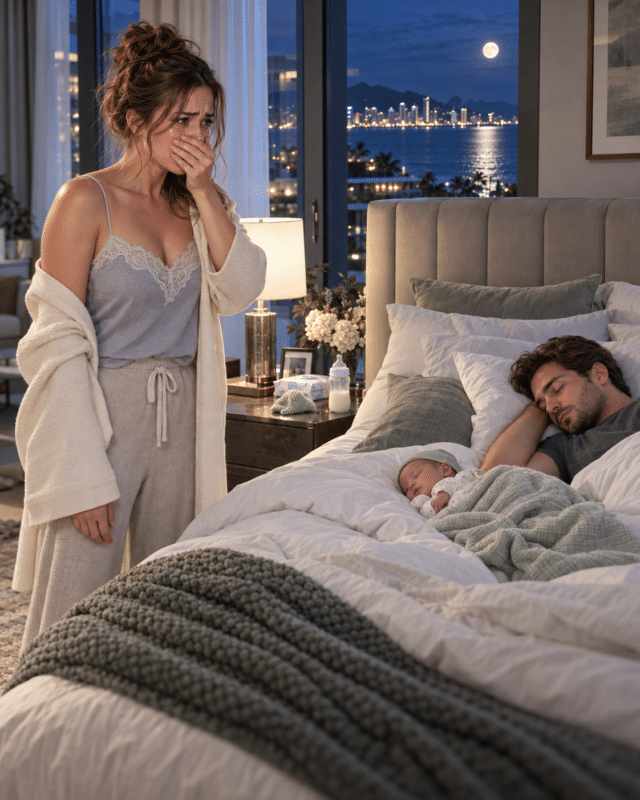
I pushed the door wider. Moonlight from the tall windows spilled across the rug, and there he was, asleep on his side of the bed, one arm tucked under his pillow the way it always was.
For one lovely second, I felt nothing but relief.
Then I looked at the other side.
My side.
A tiny baby lay sleeping beneath a pale green blanket.
There was a bottle on my nightstand. A pack of wipes next to my lamp. A little knitted cap resting exactly where I usually leave my reading glasses.
I couldn’t move.
We didn’t have a baby. We didn’t know anyone who would leave one with us. Graham was an only child who lost both parents young and grew up bouncing between relatives and temporary homes. He had no nieces, no nephews, no cousins with toddlers. He had spent his whole adult life building the stable, quiet home he never had as a boy.
There was no reasonable explanation for a newborn sleeping beside my husband.
And when there’s no reasonable explanation, a frightened mind starts inventing unreasonable ones.
I looked at Graham. Then at the baby.
My stomach turned over.
Does he have another family?
Was there someone else, all those months I couldn’t even walk past a stroller without looking away?
I stepped closer. The baby stirred, and the blanket slid down from his face.
And something happened that scared me even more than the answer I had already started to believe.
I recognized him.
Not completely. Not in any way that made sense. But the shape of his little mouth, the tiny crease between his brows, the faint dimple pressing into one cheek, all of it tugged at a memory I couldn’t quite reach.
Graham’s eyes opened.
He looked straight at me.
“Danielle?”
I wrapped my arms around myself.
“Whose baby is this?”

Part Three: A Name I Hadn’t Heard in Years
Graham sat up so fast he nearly knocked the bottle off my nightstand.
The baby squirmed. And without even thinking, Graham reached for him.
That hurt more than I expected.
He scooped the baby up, supported his head without hesitation, settled him against his shoulder, and began rubbing slow circles on his back. He didn’t fumble once. He knew exactly what he was doing.
Somehow, that was the worst part.
“How long has he been here?” I asked.
Graham looked wrecked. His hair was sticking up, his T-shirt was wrinkled, and there was a pale milk stain on his shoulder. This was a man who normally came down to breakfast looking like his shirt had been pressed while he was wearing it.
Tonight he looked like a new father on day four of no sleep.
“A few days.”
“A few days?”
“Dani, please.”
“Is he yours?”
His face changed instantly.
“No.”
He said it with such certainty that I believed him. For about half a second.
“Then whose is he?”
Graham looked down at the baby. The baby opened his eyes. Gray-blue, the exact shade mine were in every one of my childhood photos.
“His name is Eli,” Graham said quietly.
“Who named him?”
He hesitated.
“His mother.”
“And who is his mother?”
Silence.
I looked at that tiny face again, and suddenly the memory came flooding back.
My little sister, Tessa, four years old, sitting on our grandmother’s porch with strawberry juice running down her chin, and that same small dimple appearing every time she tried not to laugh.
I took a step back.
Tessa and I hadn’t spoken in almost seven years.
It started after our mother’s long illness. Months of hospital stays, bills we couldn’t pay, exhaustion that made every conversation a fight. Tessa was twenty-four and drowning. She wanted to get as far away from all of it as she could.
I was older, and I believed being older gave me the right to judge her.
In our last argument, I told her that disappearing when things got hard was the one thing she had always been good at.
Two days later, she left Georgia.
For years, I told people she needed space. That was true. What I almost never admitted was that I let her keep it. I stopped looking for her because looking meant admitting how badly I wanted her back.
Now I stared at the baby in my husband’s arms.
“Is this Tessa’s baby?”
Graham closed his eyes.
That was my answer.
I sat down hard on the edge of the bed. “Where is she?”
“St. Agnes Medical Center.”
I was on my feet again. “Why?”
“She had complications after the delivery. She’s stable now, but her doctors want to keep her for a while longer.”
“So her baby is here?”
“She asked me to take care of him until she’s discharged.”
“She asked you?”
“Yes.”
“Why you?”
Graham gently laid Eli down in the middle of the bed. The baby stretched one fist over his head and made a tiny, offended noise. Graham tucked the blanket snugly around him before he answered.
“Because Tessa called me nine weeks ago.”
Part Four: Nine Weeks
Nine weeks.
For nine weeks my husband had known where my sister was.
For nine weeks he had sat across from me at breakfast and asked if I wanted more coffee. He had listened to me complain about tile shipments and preservation boards and flight delays. He had kissed me goodbye at the airport.
“You knew where she was for two months,” I said.
“Yes.”
“And you didn’t say a word.”
He rubbed his forehead. “She made me promise.”
I laughed, but there was nothing funny in it. “That’s convenient.”
“I know how it sounds.”
“Then explain it.”
So he did.
Tessa had called him from Tucson, Arizona. At first, he didn’t believe it was really her. Then she mentioned the ugly ceramic rooster our mother used to keep on top of the refrigerator, the one Graham knocked over at his very first Thanksgiving with my family and secretly glued back together before anyone noticed.
Only our family knew that story.
She was pregnant. She was alone. And she was running out of money.
“How did she even get your number?” I asked.
Graham’s jaw tightened. “That’s part of a bigger story. I’ll get there, I promise. Let me tell it in order.”
I didn’t like it, but I nodded.
“She wasn’t asking for money,” he went on. “Not at first. She wanted advice. She was terrified of raising a baby with no one behind her. And she was even more terrified of calling you.”
“Why?”
“She thought you hated her.”
“I never hated her.”
“You know that. I know that. Tessa didn’t.”
I looked away. “Didn’t you tell her she was wrong?”
“Over and over.”
“Then why didn’t she call me?”
“Because she was scared you’d help her out of duty instead of love.” He paused. “And because I told her about last year.”
I understood immediately. Our baby. The nursery. The appointment we never kept.
“So everyone decided I was too fragile to hear the truth.”
“That’s not what happened.”
“Isn’t it?”
He didn’t answer.
I pointed at the baby on the bed. “My sister was pregnant, and you knew. She was struggling, and you knew. She came back to Georgia, and you knew. She gave birth, her son ended up sleeping in our bed, and I’m the only person in this family who didn’t know any of it.”
Graham’s shoulders dropped. “You’re right.”
That made me angrier.
“Don’t agree with me just to calm me down.”
“I’m agreeing because you’re right.”
I looked at him then, really looked. There were dark hollows under his eyes. And for the first time that night, I didn’t see a husband caught hiding something. I saw a man who had been carrying something heavy, alone, and carrying it badly.
It didn’t erase what he’d done.
It only made it harder to stay angry in a straight line.
“Why did you cancel the adoption appointment?” I asked.
He was quiet for a long time.
“Because Tessa called three days before it.”
Something cold settled in my stomach. “You canceled because of Eli?”
“Not exactly.” He sat down on the bed next to the sleeping baby. “I canceled because I realized I’d been pushing you toward another huge decision, because I couldn’t stand watching you hurt anymore. Then Tessa called, and suddenly there was another baby, another frightened person, another choice. I thought slowing everything down was the responsible thing to do.”
“Without asking me.”
“Yes.”
“That’s the problem, Graham.”
He nodded. “I understand that now.”
“No. You understand how it turned out. That’s not the same thing.”
He took that too, without arguing.
Then he crossed to the desk by the window, opened a drawer, and came back holding a cream-colored envelope.
My name was written on the front. Not Danielle.
Dee.
Tessa had called me that since before she could pronounce my full name.
My hands started shaking. “When did she write this?”
“Yesterday.”
The letter inside was short.
Tessa wrote that she didn’t expect my forgiveness and wasn’t asking me to take responsibility for her son. She only wanted me to know that Eli existed, and that every time he scrunched up his face, she saw pieces of the family she had spent seven years trying to forget.
She wrote that she would understand if I never came to the hospital.
But she hoped I would.
I read it twice.
Then Eli started to cry.
Graham moved toward him, but I got there first. I don’t know why. Instinct, maybe. I touched one finger to his soft cheek, and he went quiet.
I picked him up clumsily, terrified I was doing it wrong. But he settled against my chest like he had never had a single doubt about me. His tiny hand curled into my sweater.
Something inside me shifted.
Not healing. Healing is too neat a word for what happens when grief finally makes a little room for something new.
Eli didn’t replace anyone. He couldn’t.
But holding him reminded me that opening my heart again didn’t mean erasing what had been there before.
That was when I noticed a sheet of paper on the floor beside the desk.
I bent down carefully, Eli still in my arms, and picked it up.
FAMILY SUPPORT ASSESSMENT.
Under Parent: Tessa Brooks.
Under Temporary Contact: Graham Whitford.
And below that:
Potential Family Caregiver: Danielle Brooks Whitford.
I turned around slowly.
“Why is my name on this?”
His face tightened. “Dani—”
“Did you give them my name?”
He took too long to answer.
And that told me everything.
Part Five: The Drive
Twenty minutes later, Eli was buckled into the car seat Graham had apparently bought days earlier, and I was behind the wheel.
I insisted on driving. I had too much anger in me to sit still.
“You signed me up to take responsibility for him?”
“No. I listed you as family. As his aunt.”
“Without asking me.”
“Yes.”
“Stop saying yes like admitting it makes it okay.”
He stared out at the dark road. “I’m not trying to make it okay.”
For a few miles, neither of us spoke.
Then he said, “I was scared.”
I glanced at him. Graham was almost never scared of anything he could fix with work. He had turned one rundown inn his uncle left him at twenty-eight into a respected chain of small boutique hotels across the country. Problems, to him, were things you measured, organized, financed, and repaired.
People were harder.
“Scared of what?”
“Of asking you to love another child before you were ready.” His voice dropped. “And scared you’d say yes just because you thought it was what I wanted.”
I kept my eyes on the road. “You didn’t trust me to make my own decision.”
“I didn’t trust myself to hear your decision without trying to change it.”
That was more honest than I expected.
We drove another mile.
“You should have told me about Tessa,” I said.
“I know.”
“Even if she begged you not to.”
“I know.”
“And she should have called me herself.”
“Yes.”
I looked at Eli in the rearview mirror. He was fast asleep, his mouth making tiny sucking motions.
It struck me that every adult in his short life had been acting out of fear.
Tessa was afraid of being rejected.
Graham was afraid of reopening my grief.
And I had been so afraid of the people I loved leaving that I spent years pretending I didn’t need anyone at all.
We had all been protecting ourselves and calling it protecting someone else.
Part Six: My Sister
The maternity floor smelled exactly the way I remembered hospitals smelling, and that memory stopped me cold right outside the elevator.
Graham noticed. “We can wait out here a minute.”
“No.”
“Dani, you don’t have to prove anything.”
“I’m not.”
But my hands were shaking.
Then Eli wiggled against my shoulder and let out a soft, sleepy sigh. I looked down at him.
“I’m going in.”
A family services coordinator named Joanne Reyes met us at the nurses’ station and explained the form I had found.
It wasn’t a placement. It wasn’t legal custody. It was a preliminary assessment, standard when a new mother has complications, listing relatives who might be able to help if Tessa needed extra recovery time. Nothing could happen without my knowledge and my signature.
Graham had simply listed me as Tessa’s closest living relative.
It didn’t excuse him keeping me in the dark. But at least nobody had quietly committed me to raising a child behind my back.
“Can I see my sister?” I asked.
Joanne nodded toward a private room at the end of the hall.
When I walked in, seven years disappeared and stayed exactly where they were, both at the same time.
Tessa’s hair was longer. Her face was thinner. There were faint lines around her eyes that hadn’t been there before.
But she was still Tessa. My little sister.
She saw Eli first. Then she saw me.
Her lips parted.
“Dee.”
One word. That was all it took.
I stood in the doorway holding her son, and suddenly I was twelve and she was eight, and we were squeezed into one bed during a thunderstorm because she was terrified of lightning. I remembered teaching her to drive in the church parking lot. Fighting over sweaters. Dancing barefoot in Mom’s kitchen. And watching her walk out the door while I was too proud to go after her.
I crossed the room.
“Hi, Tess.”
Her eyes filled. “You came.”
“Apparently neither of us is very good at staying away forever.”
A small laugh escaped her. Then she pressed a hand over her mouth.
“I’m so sorry.”
For years, I had imagined this moment. I had rehearsed speeches. Arguments. Questions.
None of them mattered anymore.
“So am I,” I said.
She shook her head. “You don’t have anything to be sorry for.”
“Yes, I do.” I sat down beside her. “I was hurting, and I made you responsible for it. Mom was sick, I was scared, and I decided that because I stayed, you weren’t allowed to be scared enough to leave.”
Tessa looked down at her hands. “I shouldn’t have disappeared.”
“No,” I agreed.
She gave me a sad little smile. “Still bossy.”
“Still running?”
For half a second, we just looked at each other.
Then we both laughed. Quietly. Carefully. Like two people testing whether an old bridge could still hold their weight.
I laid Eli beside her, and the moment she touched him, her whole face softened. There was no question she loved her son.
But love and confidence aren’t the same thing.
Eventually, she told me the truth. She didn’t have a real home ready for him. Her savings were nearly gone. A friend in Tucson had offered her a spare room, but she didn’t know how she’d manage a newborn on her own while she healed.
“I thought being his mom meant I’d automatically know what to do,” she whispered.
“Nobody knows what they’re doing at the beginning.”
“You always did.”
I almost laughed. “Tess, I’ve spent half my adult life pretending I know what I’m doing.”
She looked at me. “What if loving him isn’t enough?”
I took her hand. “Then you let people help.”
She swallowed hard. “I didn’t come back to make you responsible for us.”
“You’re not.”
“I don’t want you helping because you feel sorry for me.”
“I don’t.”
“Or because Graham expects you to.”
I glanced at the doorway, where my husband had wisely decided to stay silent.
“Graham is in no position to expect anything from me right now.”
She almost smiled. Then she grew serious again.
“Then why?”
I looked at my sister. For years I had believed forgiveness could only come after someone explained everything properly. Sitting beside her, I finally understood that sometimes no explanation is ever big enough.
Sometimes forgiveness starts simply because two people are tired of carrying the same old pain.
“Because you’re my sister,” I said. “Because Eli is your son. And because seven years is already too long.”
Her face crumpled. She squeezed my hand.
“I wanted you to come find me.”
“I should have.”
“I also wanted you to leave me alone.”
This time I laughed through my tears. “That sounds more like you.”
“I was complicated.”
“You still are.”
“So are you.”
“It runs in the family.”
For the first time all night, the room felt lighter.
Then Tessa glanced at Graham, and something in her expression changed. Just slightly. But I caught it.
“There’s something else,” she said.
Graham straightened. “Tess, you don’t have to do this tonight.”
She shook her head. “I’ve spent enough years waiting for the perfect time.”
I looked between them. “What are you talking about?”
Tessa took a breath.
“Eli’s father.”

Part Seven: The Last Secret
I had assumed Eli’s father had simply walked away. Tessa hadn’t mentioned him in her letter. Graham hadn’t said a word either, and suddenly that silence felt important.
“Who is he?” I asked.
Tessa looked down at her son.
“His name was Marcus Hale.”
Was.
The name meant nothing to me. But beside me, Graham went completely still.
“You knew him,” I said.
“I did.”
Tessa closed her eyes, and Graham told the rest.
Marcus had worked for Whitford Inns as a regional restoration manager, overseeing several of Graham’s historic properties across the Southwest. He met Tessa in Tucson. They fell in love fast, though it was complicated by his constant travel and Tessa’s fierce need to stand on her own.
Five months before Eli was born, Marcus was driving between two properties at night. He never made it home.
“I went to his memorial in Arizona,” Graham said quietly. “You were buried in the Asheville project that month. I told you a site manager had died. I didn’t know about Tessa then. Nobody did.”
I remembered. He had come home from that trip and barely spoken for days. I had thought it was about us.
“Three months later,” Tessa said, “I was cleaning out the last of Marcus’s things. There was a folder from work. His emergency contact form.” She looked at Graham. “He’d listed his boss. Graham Whitford. With a personal cell number.”
“And you recognized the name,” I said.
“I stared at it for an hour.” Her voice wavered. “Of all the people in the world, the man Marcus trusted most was my sister’s husband.”
That was how she had found him. Not because Graham had money. Not because she expected him to fix her life. Because Marcus had already pointed her toward him, without ever knowing why it mattered.
“Why didn’t you just call me then?” I asked.
Her eyes filled again. “Because by the time I found that number, my whole life had fallen apart. I couldn’t stand the thought of calling you for the first time in seven years only because I had nowhere else to go.”
I understood that more than I wanted to.
Pride had kept us apart just as effectively as anger ever had.
“She came back to Georgia for the last month of her pregnancy,” Graham said. “She wanted Eli born here. Near home. Near you, even if she wasn’t ready to see you.”
Tessa nodded slowly. “And there’s one more thing. Marcus knew about Eli. I told him two weeks before the accident.” She rested her hand over the baby’s blanket. “He was happier than I had ever seen him.”
Graham looked toward the window.
“After he died, our legal team found that Marcus had updated his employment paperwork,” he said. “Just days before the crash.”
My stomach tightened. “What paperwork?”
Tessa answered for him.
“He left something for Eli.”
Graham reached into the inside pocket of his jacket and pulled out a small sealed envelope. He held it out to me.
On the front, in handwriting I didn’t recognize, were four words.
For my son. Someday.
I took it. The paper was soft at the corners, like it had been carried around for a long time.
Then I shook my head and placed it in my sister’s hands.
“This isn’t mine to open, Tess.”
Part Eight: What Marcus Left
Tessa stared at the envelope for a long moment. Then she slid her thumb under the flap.
Inside was a single folded page and a copy of a benefits form.
She read the letter first. Her lips moved silently. Halfway down, she had to stop and press the back of her wrist to her eyes.
Then she handed it to me.
It wasn’t long. Marcus wrote that he was terrible at saying important things out loud, so he was writing them down instead. He wrote that he didn’t know yet if his son would have his stubbornness or Tessa’s, but he hoped for both. He wrote that he had changed his life insurance and his retirement account so that if anything ever happened to him, his child would never have to wonder whether he was wanted.
And at the bottom:
Your mom is braver than she thinks. If she ever forgets that, find the people who love her and make them remind her.
I looked up at my sister.
“He named Eli as the beneficiary,” Graham said gently. “The company policy and his retirement savings. It’s held in trust until he’s eighteen, but Tessa can draw from it for his care. Our lawyers finished the paperwork last week. That’s what I was carrying around, and I didn’t know how to give it to her without explaining everything else.”
Tessa was crying openly now. “He knew,” she whispered. “He actually planned for us.”
It wasn’t a fortune. But it was enough. Enough for a real home. Enough that Tessa wouldn’t have to choose between rent and diapers. Enough that she wouldn’t have to start motherhood terrified every single day.
I folded the letter carefully and handed it back to her.
“He told you to find the people who love you,” I said. “You found us.”
She laughed through her tears. “Technically, I found your husband.”
“Close enough.”
Epilogue: The Door Across the Hall
Tessa was discharged eight days later.
She and Eli came home with us. Not forever. Just until she was strong enough, and until we all figured out what came next.
On her first night back at the house, I stood in the upstairs hallway for a long time, my hand resting on the door of the room across from ours.
The room neither of us had opened in a year.
Graham came up behind me. He didn’t say anything. He just waited, the way he should have waited a year ago, for me to decide.
I turned the handle.
The crib we had assembled together was still there, a thin layer of dust on the rail. The rocking chair. The little lamp shaped like a moon.
It hurt. It still does, some days.
But that night, my nephew slept in that crib while my sister slept in the guest room next door, and for the first time in a very long time, the house sounded like people lived in it.
Graham and I started seeing a counselor the following month. Together this time. He has a lot to answer for, and he’s answering for it, one honest conversation at a time. I’m learning to say what I need out loud instead of waiting for people to guess. Neither of us is very good at it yet.
But we’re trying. In the same room. With the door open.
Tessa found an apartment fifteen minutes away in the spring. She comes over every Sunday for dinner, and every Sunday she and I argue about something ridiculous, and every Sunday it feels like a small miracle.
Last week, Eli smiled for the first time while I was holding him. That little dimple appeared in his cheek, and Tessa gasped.
“He’s going to look just like you,” she said.
“No,” I told her. “He’s going to look just like you. I’m just going to be the one who tells him all the embarrassing stories.”
She threw a dish towel at me.
I caught it, laughing, and thought about that Tuesday night. How I came home early hoping to save my marriage, and found a stranger’s baby on my side of the bed.
He was never a stranger.
He was the thread that led me home.
[Note: This story is a work of fiction inspired by real events. Names, characters, and details have been altered. Any resemblance is coincidental. The author and publisher disclaim accuracy, liability, and responsibility for interpretations or reliance. All images are for illustration purposes only.]