I Was 34 Weeks Pregnant and One Phone Call From Losing My House When I Mowed My 82-Year-Old Neighbor’s Lawn in the Brutal Heat—At Dawn, a Sheriff Was Pounding on My Door, Asking Me to Open My Mailbox While He Watched
I Was 34 Weeks Pregnant and One Phone Call From Losing My House When I Mowed My 82-Year-Old Neighbor’s Lawn in the Brutal Heat—At Dawn, a Sheriff Was Pounding on My Door, Asking Me to Open My Mailbox While He Watched
My boyfriend walked out the day I decided to keep our baby. The bank called to say they were taking my house. And on the hottest afternoon of the summer, I dragged my swollen body across an old widow’s overgrown lawn because I couldn’t stand to watch her struggle alone. The next morning, sirens tore me out of sleep, a sheriff stood in my living room with bad news, and he said four words I will never forget: “Check your mailbox, please.”
Part 1 – I Was 34 Weeks Pregnant and One Phone Call
I always thought rock bottom would make some kind of noise.
A crash. A slammed door. A scream. Something you could point to afterward and say, That was it. That was the moment everything fell apart.
But when I finally hit it, rock bottom didn’t sound like anything at all.
It sounded like silence. The hum of a refrigerator in an empty kitchen. The tick of a wall clock nobody else was there to hear. The rustle of envelopes I was too afraid to open.
I was 34 weeks pregnant, and I was completely alone.
I used to be a planner. I was the woman with the color-coded calendar, the emergency fund, the grocery list sorted by aisle. I believed, with my whole heart, that if you were careful enough, nothing could truly blindside you.
Then I told Lee I was pregnant.
He stood in our kitchen, stared at the positive test on the counter like it was a bill he didn’t intend to pay, and said, “You know I never wanted this, Ariel.”
I told him I was keeping the baby.
He was gone within the week. His half of the closet was empty. His half of the mortgage stopped coming. His phone went straight to voicemail, and after a while, I stopped calling.
You can’t plan for a man like that. You can’t plan for a mortgage company that doesn’t care why the payments are late. You can’t plan for the way overdue notices pile up on the kitchen counter, one on top of another, like a slow, silent avalanche that you know is going to bury you eventually.
I worked as long as my body let me. I picked up extra shifts. I sold Lee’s old guitar and the good dining chairs and the bracelet my grandmother left me. It wasn’t enough. It was never going to be enough.
And every night, I lay in bed with my hand on my belly, feeling my daughter roll and stretch beneath my palm, and I whispered promises I had no idea how to keep.
That Tuesday was the hottest day of the summer.
It was the kind of heat that feels personal. Thick, sticky, oppressive. The air outside shimmered above the asphalt, and even inside, with every fan in the house running, the rooms felt like the inside of a closed car.
I had put off the laundry for days. My back ached, my ankles had disappeared weeks ago, and bending over felt like a negotiation. But the clean clothes had formed a small mountain on the couch, so I lowered myself down beside it and started folding, slowly, one tiny onesie at a time.
The phone rang.
I jumped so hard the clothes tumbled off my lap and onto the floor.
I looked at the screen. My stomach dropped.
Caller ID: Bank.
For a long moment, I just stared at it. I thought about letting it go to voicemail. I thought about throwing the phone across the room. Instead, like a woman walking toward her own sentencing, I answered.
“Hello?”
“Hi, is this Ariel? This is Brenda, calling from the loss mitigation department.”
Her voice was polite. Professional. Practiced. The voice of someone who made calls like this every day and had learned to stop hearing the people on the other end.
She read off the balance past due. She listed the dates of the missed payments. She explained the notices I had received, the ones I had shoved into a kitchen drawer so I wouldn’t have to look at them.
Then she paused.
“Ma’am, I’m afraid I have some difficult news regarding your mortgage,” she said. “Foreclosure proceedings are beginning as of today.”
Something inside me broke. Quietly. Cleanly. Like a bone snapping under a blanket.
I didn’t say goodbye. I didn’t ask questions. I just pulled the phone away from my ear, ended the call, and pressed my palm flat against my belly.
“I’m so sorry, baby,” I whispered. “I’m trying. I promise I’m trying.”
She kicked. Hard. Right under my hand.
It felt like she was saying, Don’t you dare give up.
But I couldn’t breathe in that house. The walls felt like they were closing in, the unpaid bills staring at me from the counter. I needed air. Just one breath that didn’t taste like fear.
So I pushed myself up off the couch, shoved my feet into my sandals, and stepped outside to get the mail.
Part 2
The sunlight hit me like a slap.
I squinted, shielding my eyes, and shuffled down the walkway to the mailbox. More envelopes. More bad news, probably. I tucked them under my arm without looking.
That’s when I saw her.
Mrs. Higgins had lived next door for as long as I’d owned the house. She was 82 years old, tiny and neat, her silver hair always pinned up in the same careful twist. On most days, you could find her on her porch in a cushioned wicker chair, a crossword puzzle on her knee and a glass of iced tea sweating beside her.
But today, she wasn’t on her porch.
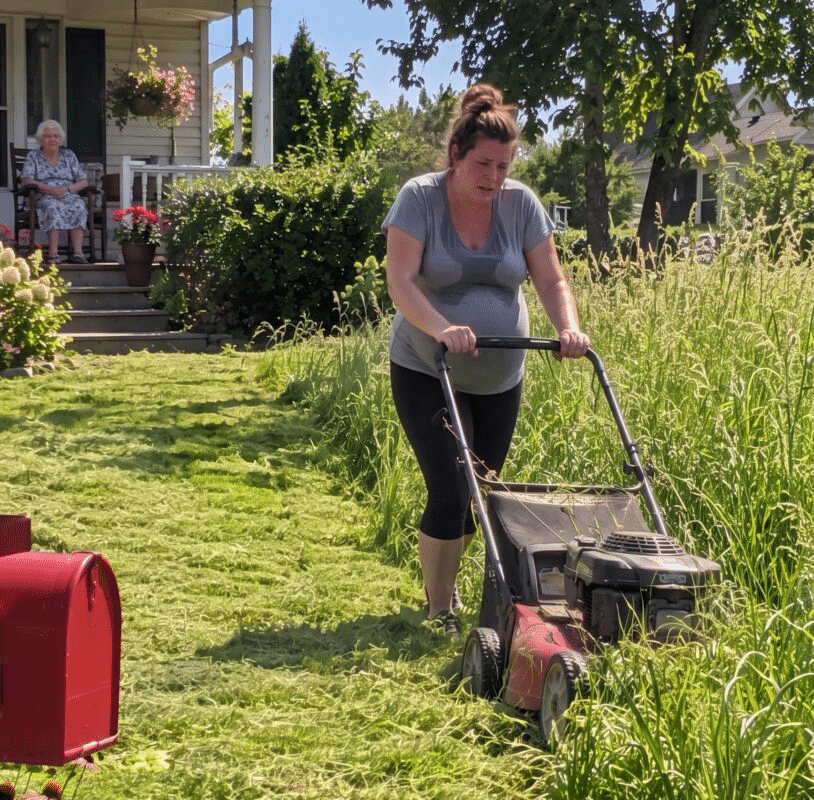
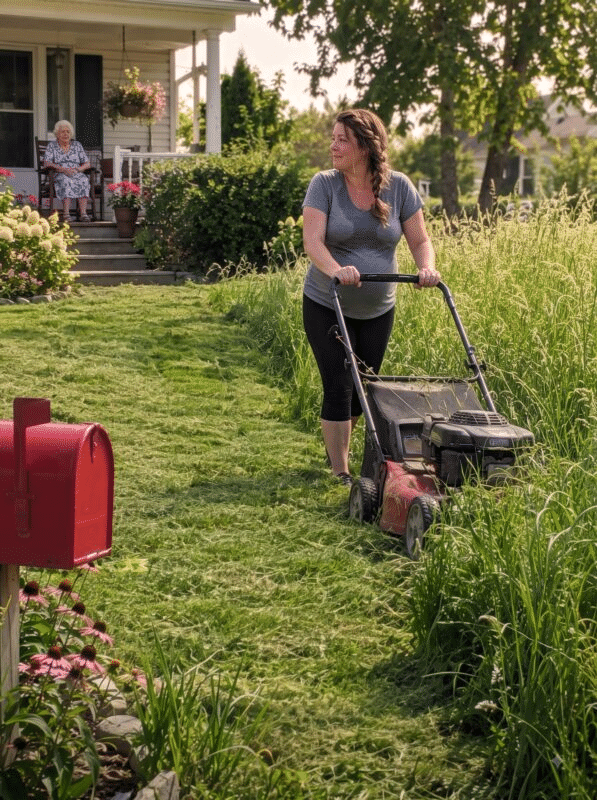
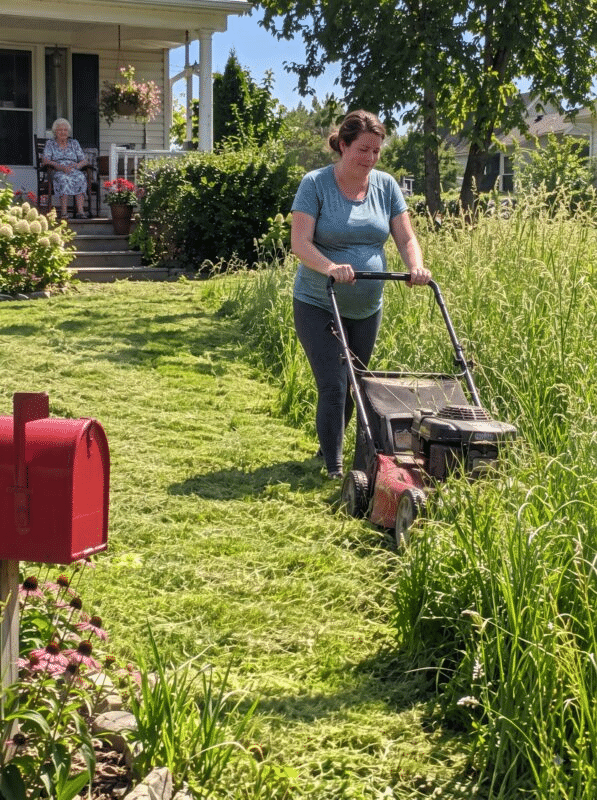
She was in her yard, bent nearly double behind a mower so old it could have belonged in a museum. She was pushing it with both hands, her whole body leaning into it, inching forward through grass that had grown so tall it nearly swallowed her shins.
I stopped at the edge of my driveway and just watched her for a second.
She must have heard my sandals scrape the concrete, because she looked up. She wiped the sweat from her forehead with the back of her wrist and gave me a smile that wobbled at the edges.
“Morning, Ariel!” she called. “Beautiful day for a little yard work, isn’t it?”
Her voice was bright. Cheerful. But I could see her chest heaving. I could see the way her arms trembled on the handle.
Just then, the mower hit a hidden clump of weeds, jerked, sputtered, and died with a long, tired groan.
Mrs. Higgins sighed and stared down at it like an old friend who had finally let her down.
I hesitated.
I’m ashamed to admit it, but I did.
The sun was baking the back of my neck. My back throbbed. My feet were swollen inside my sandals. And the very last thing I wanted, on the worst day I’d had in months, was to play the hero for somebody else.
A hundred thoughts rushed through my mind in a single second. The foreclosure. The empty closet. The bills tucked under my arm. Every way I had failed. Every way I was still failing.
For one heartbeat, I almost turned around and went back inside.
But then I looked at her again. She was blinking fast, one hand pressed against her chest, struggling to catch her breath.
And I couldn’t do it. I couldn’t walk away.
“Mrs. Higgins, do you want me to grab you some water?” I called, already walking toward her.
She waved me off, pride stitched into every line of her face. “Oh, heavens, no. I’m perfectly fine. I just need to finish this before the HOA starts their rounds this afternoon. You know how they are.”
I tried to laugh. “Don’t remind me.”
She grinned, but she didn’t let go of the mower.
“Seriously,” I said, stepping onto her lawn. The grass tickled my ankles. “Let me help. You shouldn’t be out here in this heat.”
She frowned at me, then pointedly at my stomach. “It’s too much for you, dear. You should be at home with your feet up, not mowing lawns for old ladies.”
I shrugged. “Resting is overrated. Besides, I could use the distraction.”
She tilted her head, studying me with sharp, pale blue eyes that missed absolutely nothing.
“Trouble at home?”
I opened my mouth. Closed it. Forced a smile.
“Nothing I can’t handle.”
She didn’t believe me. I could tell. But she didn’t push, either. Instead, very slowly, she loosened her grip on the handle, then let go entirely. She lowered herself onto her porch steps with a long, grateful sigh.
“Thank you, Ariel,” she said softly. “You’re a lifesaver.”
I set the bills down on her porch railing, yanked the pull cord, and the old mower coughed back to life.
The first few passes weren’t so bad. Then the heat started to climb inside me. The grass was thick and wet at the roots, and my sandals squelched with every step. My belly pulled the mower’s handle toward me at an awkward angle. Sweat rolled down my spine. A wave of dizziness rose up, then faded, then rose again.
But I kept going. Back and forth. Back and forth.
Every time I turned at the end of a row, I caught Mrs. Higgins watching me from the steps. There was a strange, thoughtful look on her face. Not pity. Something deeper than that. Like she was working out a puzzle she’d been given, and she was getting close to the answer.
About halfway through, my breath caught in my throat. The world tilted a little. I stopped, leaned my whole weight against the handle, and pressed my forearm to my face.
When I lowered it, Mrs. Higgins was standing beside me with a tall glass of lemonade, ice clinking, the outside of the glass beaded with cold water.
“Sit,” she ordered. “Right now. You’ll make yourself sick.”
I didn’t argue. I followed her to the porch and sank onto the top step, gulping the lemonade so fast it made my teeth ache. My pulse was racing.
Mrs. Higgins eased down beside me. For a while, she didn’t say a word. She just reached over and patted my knee, twice, the way my grandmother used to.
After a minute, she asked, “How much longer for you?”
I looked down at my belly. “Six weeks. If she lets me go that long.”
“A girl,” she said, and something in her face softened. She smiled, a little wistful. “I remember those days. My Walter was such a nervous wreck. He packed the hospital bag a full month early and kept checking it every night, like the clothes might have wandered off.”
I laughed. It surprised me how good it felt.
Her hand trembled slightly as she lifted her own glass to her lips.
“He sounds like a good man,” I said.
“Oh, he was, Ariel. He was the best.” She was quiet for a moment, gazing out at the half-mowed lawn. “It gets lonely, you know. When you lose the one person who remembers all your stories. Nobody else knows the beginning of the jokes anymore.”
Then she turned and looked straight at me.
“Who’s in your corner, Ariel?”
The question hit me harder than the heat. I stared out at the street and willed myself not to cry. I lost.
“Nobody,” I said. “Not anymore. My ex, Lee, walked out when I told him I was pregnant. And this morning, the bank called. They’re starting foreclosure.” My voice cracked. “I don’t know what happens next. I really don’t.”
Mrs. Higgins didn’t gasp or cluck her tongue. She just studied my face, very carefully, like she was reading something written there in small print.
“You’ve been doing all of this by yourself,” she said.
I gave her a watery half-smile. “Looks that way. I’m stubborn, I guess.”
“Stubborn is just another word for strong,” she said. “But even strong women need somebody to hand them a glass of lemonade once in a while.”
Part 3
The rest of the lawn took forever.
My body screamed at me with every step. My lower back felt like it was full of broken glass. But finishing was the only thing that made sense to me anymore. Everything else in my life was slipping out of my control, but this one thing, this one stupid overgrown lawn, I could fix.
When I finally pushed the mower into the last corner and cut the engine, the silence rang in my ears. I wheeled it back beside her porch, wiped my hands on my shorts, and tried not to notice that my vision had gone slightly blurry at the edges.
Mrs. Higgins came down the steps and took my hand in both of hers. Her grip was surprisingly firm.
“You’re a good girl, Ariel,” she said. “Remember that.”
She looked at me with a strange, unsettling intensity, her eyes moving slowly across my face, like she was memorizing it.
“Don’t you let this world take that away from you.”
I didn’t know what to do with that, so I tried to make a joke.
“If the world wants anything from me today, it’s going to have to wait until I’ve had a nap.”
She laughed, but her eyes stayed serious. “Go get some rest, honey.”
I grabbed my stack of mail off the railing and waved as I trudged back across the yard, grateful for the shade of my own porch.
That night, I lay in bed with the fan whirring and one hand resting on my belly. I stared at the thin cracks spidering across the ceiling. I thought about Walter packing that hospital bag a month early. I thought about Mrs. Higgins patting my knee.
For the first time in months, I felt lighter. Just a little. Just for a moment.
I didn’t know it would be the last time I ever saw her.
A siren tore me out of sleep.
I bolted upright, heart slamming, one hand flying to my stomach. Blue and red lights were streaking through the gaps in my blinds, sweeping across my bedroom walls in wild, panicked stripes.
For one frantic second, my mind raced to the worst places it could find. Maybe Lee had come back to make some kind of scene. Maybe the bank had already sent someone to throw me out. Maybe I had done something wrong without even knowing it.
I grabbed the first cardigan I could find, pulled it on over my sleep shirt, and stumbled to the front door.
When I stepped outside, the street looked like a circus.
Two patrol cars sat at angles along the curb, lights still spinning. A sheriff’s SUV was parked right in front of my house. Neighbors had drifted out onto their lawns in robes and slippers, clutching coffee mugs, faces pinched with curiosity. A few of them turned to look at me the second my door opened.
And they were all standing near one house.
Mrs. Higgins’ house.
A cold feeling crept up the back of my neck. I tucked a loose strand of hair behind my ear, lifted my chin, and stepped onto the porch, trying to look braver than I felt.
A tall man in a tan uniform broke away from the cluster of officers and walked toward me. He was broad-shouldered and serious, with graying temples and the kind of steady presence that makes you want to stand up straighter.
“Ma’am. Are you Ariel?”
His voice was clipped, but not unkind.
I nodded. My mouth had gone completely dry.
His eyes flicked briefly toward the neighbors watching us, then back to me.
“I’m Sheriff Holt. Would it be all right if we stepped inside for a moment?”
I held the door open, and he followed me in.
My little living room suddenly felt far too small with him standing in it. The radio clipped to his shoulder crackled with quiet static. His gaze moved slowly over the room: the framed photos on the bookshelf, the half-folded laundry still heaped on the couch, the stack of unopened mail on the side table, with the bank’s logo peeking out from the top envelope.
“Is everything okay?” I managed.
He took off his hat and held it in both hands. That was when I knew.
“I wish I could tell you it was,” he said, lowering his voice. “Mrs. Higgins collapsed on her front porch early this morning. A neighbor out walking his dog saw her and called it in. The paramedics got there as fast as they could, but…”
He didn’t finish the sentence. He didn’t have to.
“She didn’t make it,” I whispered.
My legs gave out, and I sank down onto the couch, right on top of the laundry.
Sheriff Holt nodded gently. “I’m very sorry.”
I pressed my hand over my mouth. Just yesterday, she had been holding my hand in both of hers. Just yesterday, she had told me I was a good girl. She had been fine. Tired and hot and proud, but fine.
“I know you helped her out yesterday,” the sheriff went on. “One of your neighbors mentioned seeing you out there mowing her lawn.”
“She was struggling,” I said, my voice thin. “It was so hot. I couldn’t just watch her.”
“That was kind of you.” He shifted his weight. “Ariel, there’s something else. When we’re called to a scene like this, we have to piece together the person’s last movements. Mrs. Higgins had a doorbell camera on her porch. We reviewed the footage this morning.”
I looked up at him, confused.
“Very early this morning, before sunrise, she walked across her yard to your house,” he said. “She put something in your mailbox. Then she went back home, sat down on her porch, and…” He paused. “That was the last thing she did.”
I stared at him.
“She put something in my mailbox?”
He nodded.
“What?”
“I don’t know yet,” he said. “It’s addressed to you, so I’d rather not open it myself. But given the circumstances, I’d like to be there when you do. Would you check your mailbox for me, please?”
My hands curled into the fabric of the couch cushion. My mind was spinning, grasping for something that made sense.
“What could she possibly have left for me?”
Sheriff Holt gave me a small, sad smile.
“Let’s go find out together.”
Part 4
The walk down my driveway felt a hundred miles long.
The whole street had gone quiet. A neighbor’s little boy was riding his bike up and down the sidewalk in slow circles, shooting curious glances in my direction. Across the road, Ms. Pearson stood on her porch in a bathrobe, arms crossed tightly over her chest. In all the years I’d lived on that street, she had never said more than five words to me.
She was watching every step I took.
My hands were shaking so badly that I fumbled the little mailbox key twice before it finally slid into the lock. It felt heavier than usual somehow. Its sharp edges bit into my palm.
I turned it. I opened the door. My heart was in my throat.
Inside, lying flat on the bottom of the box, was a thick manila envelope.
My name was written across the front in careful, looping script. Old-fashioned handwriting. The kind they don’t teach in schools anymore.
Ariel.
Sheriff Holt gave me a nod. I reached in and slid it out.
As I did, a second envelope came with it, thinner, tucked neatly behind the first. I turned it over.
It bore my bank’s logo.
And stamped across the front, in bold red ink, were three words.
PAID IN FULL.
My knees buckled.
The sheriff caught my elbow before I could fall. “Whoa. Easy. You all right?”
“I, I don’t understand,” I gasped. I couldn’t get enough air. “How is this… how could she…”
He steadied me until I found my footing, then nodded toward the manila envelope trembling in my hands.
“I think the answer’s probably in there,” he said quietly. “Let’s open it.”
My fingers wouldn’t work properly. I tore at the flap clumsily until it finally gave.
Papers slid out into my hands. Legal forms, crisp and official. A copy of my deed, with a satisfaction of mortgage stapled to the front. A receipt from the bank with a date and a time from yesterday afternoon, only a couple of hours after I had finished mowing.
And, folded neatly in half, a single sheet of cream stationery with my name written across the outside.
I tried to read it. I really did. But my eyes had filled so completely with tears that the words swam and blurred into nothing.
I held the note out toward the sheriff.
“May I?” he asked gently.
I nodded, lips pressed together so hard they hurt.
He unfolded the paper carefully, like it might crumble. Then he took off his hat again, tucked it under his arm, and turned slightly toward me, lowering his voice so the neighbors couldn’t hear.
“I’m not usually the one who does this kind of thing,” he said, almost apologetically.
Then he cleared his throat and began to read.
“Ariel,
After you told me about the bank, I kept thinking about it while you finished my lawn. Then, when you’d gone home, I noticed one of your letters had slipped out of the stack you left on my railing. I know I shouldn’t have read it. But when I saw the word foreclosure, and the number beneath it, I couldn’t just put it back and pretend I hadn’t.
So while you were home taking your nap, I called my banker. Then I took Walter’s rainy day fund straight down to the bank and signed the papers myself. Walter always said that money was for the day when it was really pouring. Well, honey, I’ve never seen it rain harder on anybody than it’s been raining on you.
You gave me kindness when you didn’t have any left to spare. You looked at a slow old woman sweating behind a broken mower, and you saw a person. Not a nuisance. Not a chore. A person. Most people haven’t done that for me in a very long time.
That’s why I wanted to see you safe, too.
You don’t owe me a single thing. Just promise me you’ll be as good to yourself as you were to me. Women have to look out for women, especially when nobody else will.
Be brave. Be kind. And always remember: what you did mattered.
P.S. I’ve always loved the name Will for a boy. And Mabel for a girl.
With love,
Mrs. Higgins”
Part 5
A sob broke out of me. Sharp and ragged and grateful all at once.
It wasn’t the polite, quiet kind of crying. It came up from somewhere deep in my chest, from all the months of holding everything together by myself, from every night I’d lain awake doing math that never added up.
Sheriff Holt didn’t say anything. He just rested his hand on my shoulder and let me cry.
For the first time in months, the world didn’t feel quite so empty.
Around us, the street had gone completely silent. The little boy on his bike had stopped at the end of my driveway. Ms. Pearson had uncrossed her arms and put a hand over her heart.
Nobody said a word.
I pressed my palm to my belly. My daughter shifted beneath it, slow and sleepy.
“We’re staying, baby,” I whispered. “Do you hear me? We’re staying.”
Sheriff Holt walked me back up to my house. He carried the envelopes inside and set them carefully on the kitchen table, right on top of the pile of overdue notices, as if they were covering them up.
At the door, he paused and pulled a business card from his breast pocket.
“If you need anything,” he said, “anything at all, you call the station. Ask for me by name.”
I took the card and nodded. “Thank you. For reading it. I couldn’t have.”
He put his hat back on and gave me a small nod. “She picked the right person, ma’am. I’d bet my badge on it.”
Then he was gone.
Around noon, my phone lit up on the kitchen counter.
Lee.
I stared at his name for a long time.
Maybe someone on the street had already texted him about the sheriff’s cars outside my house. Maybe he thought I was in trouble. Maybe he thought I finally needed him, and he wanted to be the one who swooped in, or the one who got to say I told you so.
It didn’t matter.
I let it ring.
It rang and rang and then went quiet. A minute later, a voicemail notification popped up. I didn’t listen to it.
For once, not answering didn’t feel lonely.
It felt like peace.
Part 6
The rest of the day passed in a blur.
The bank called, and this time, it wasn’t Brenda. It was a manager, careful and almost apologetic, confirming that my loan had been paid off in full and that all foreclosure proceedings had been permanently stopped. I asked him to repeat it twice, just to be sure I’d heard it right.
Sheriff Holt stopped by in the afternoon with a few forms for me to sign as a witness, and a quiet update: Mrs. Higgins had a nephew out in Oregon, and he’d been notified. The doctor believed it was her heart. It had been very quick, he told me. She hadn’t suffered.
I held on to that.
And all day long, something strange kept happening. Neighbors kept slowing down as they walked past my porch. People I had waved to politely for years, but never really spoken to, lifted their hands and called out to me by name. Someone left a casserole dish on my step with a sticky note that just said Thinking of you.
It was like the whole street had seen me for the first time.
Late in the afternoon, Ms. Pearson came down off her porch and crossed the road. She stopped at the bottom of my steps, looking deeply uncomfortable, twisting her wedding ring around and around her finger.
“She talked about you, you know,” she said finally. “Edith did. She said you always waved at her. Even on days you looked like you were carrying the whole world.”
I hadn’t even known her first name was Edith.
“I’m sorry I never came over,” Ms. Pearson said. Then she gave me a short, awkward nod, the kind of nod that costs a proud person something. “If you need a ride to the hospital when the time comes, I’m right across the street.”
“Thank you,” I said. And I meant it.
By sunset, the street had emptied out again.
The patrol cars were long gone. The neighbors had drifted back inside for dinner. Somewhere down the block, a sprinkler ticked in a slow circle.
I sat on my front steps in the fading light, the air finally cooling, and laid everything out across my lap. The deed with my name on it. The bank’s letter with those three red words. And Mrs. Higgins’ note, the paper already soft from how many times I had unfolded it that day.
Across the yard, her lawn lay neat and even, the rows I had cut still visible in the grass. Her wicker chair sat empty on the porch. Her crossword was still on the little table beside it, half finished, a pencil resting across the page.
My daughter kicked, strong and sure. I rested my hand over the spot.
“Thank you, Mrs. Higgins,” I whispered into the dusk. “I don’t know how I’ll ever repay you. But I’ll pay it forward. I swear I will.”
A warm breeze moved through the maple tree overhead, and the leaves rustled softly, almost like an answer.
I smiled through my tears and looked down at my belly.
“We made it,” I whispered. “We’re home, baby girl.”
Then I picked up the note one more time and ran my thumb across the last line in her careful, looping handwriting.
“And I know your name now,” I told my daughter.
“Mabel.”
Note: This story is a work of fiction inspired by real events. Names, characters, and details have been altered. Any resemblance is coincidental. The author and publisher disclaim accuracy, liability, and responsibility for interpretations or reliance. All images are for illustration purposes only.