

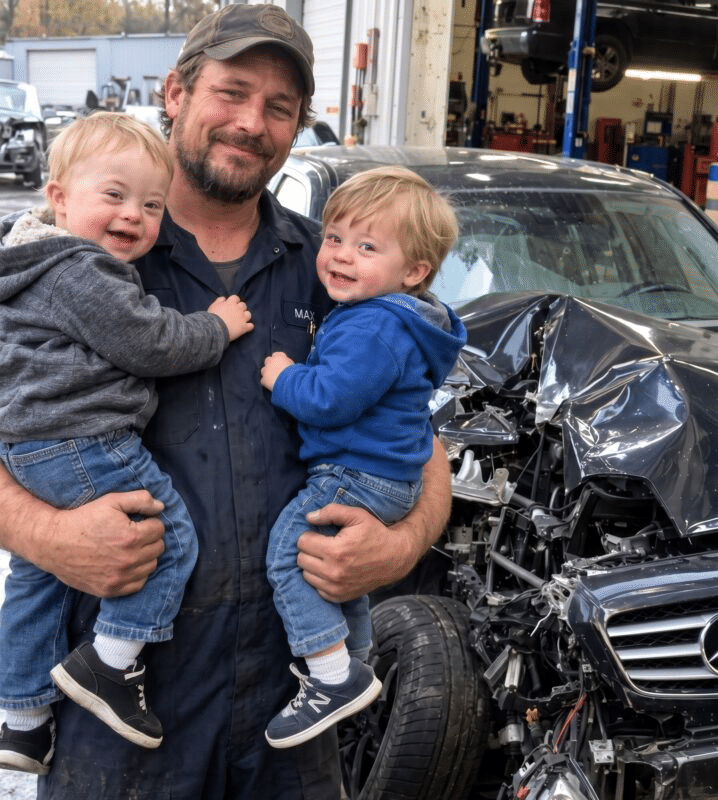
My Ex-Wife Threatened to Take My Sons Unless I Fixed Her Wrecked Mercedes
For two years, she used my boys like a leash. She thought one more tug would keep me quiet forever. She never imagined that a single sentence on a piece of paper, one she didn’t bother to read, would be the thing that finally set me free.
Part One: The Words I Heard Every Morning – Ex-Wife
Some people forget the cruel things they say the moment the words leave their mouths.
The people who hear them never do.
Laura and I had been divorced for a little over two years when she pulled a wrecked Mercedes into my repair shop one Monday morning. By then I had learned a lot of things about her that I’d somehow missed during eleven years of marriage. But that day taught me the most important lesson of all.
Some people never stop searching for the place where it hurts. And once they find it, they keep pressing.
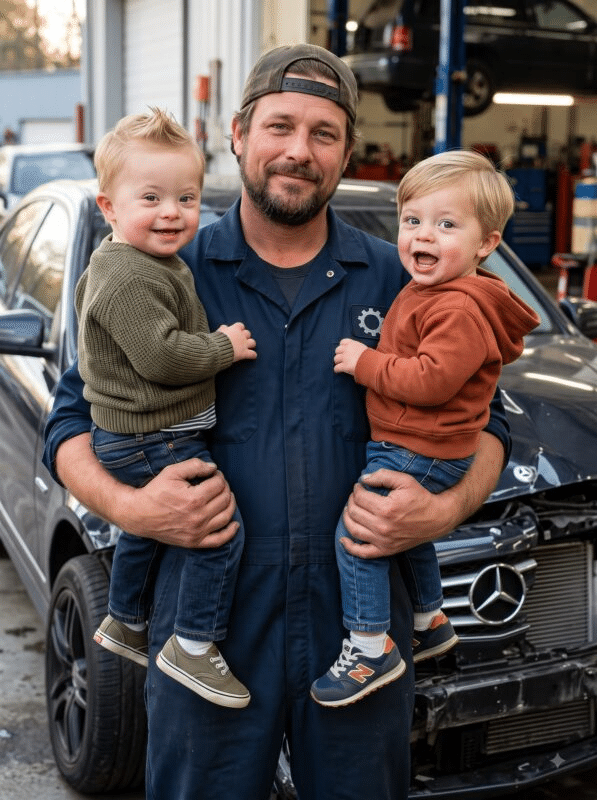
We met when we were both twenty-four. She was bright and funny and ambitious, and I was a guy with grease under his fingernails who thought the world of her. We had two boys together, Rick and Noah. Rick was eleven now, old enough to roll his eyes at everything I said and still young enough to want me at every one of his games. Noah was eight, all elbows and questions, the kind of kid who could talk for forty straight minutes about volcanoes without taking a breath.
They were the best thing I ever did. The best thing we ever did.
Then Laura left me for Brent.
Brent and I had gone to high school together. Back then he was the kid with the new truck and the lake house and the father who owned half the car dealerships in the county. Twenty years later, not much had changed, except now the truck was a Range Rover and the lake house was his.
When Laura packed her things, she didn’t bother softening the reason. She stood in our bedroom folding sweaters into a suitcase like she was getting ready for a vacation.
“You’ve been stuck in the same place for years, Craig,” she said.
“I’m working.”
“You’re surviving.” She zipped the bag shut. “There’s a difference.”
I remember standing in the doorway, trying to think of something to say that would make her stop. Nothing came.
Then she looked at me and gave me the sentence I would carry around for the next two years.
“You’re going nowhere in life, and you’ll never be able to make decent money.”
She said it calmly. That was the worst part. She wasn’t yelling. She wasn’t crying. She said it the way you’d read a weather report, like it was simply a fact she’d finally accepted.
After she left, I heard those words every single morning. I heard them when I woke up alone. I heard them in the shower. I heard them most clearly when I turned my key in the lock of my own repair shop, because that shop was the one thing I was building to prove her wrong.
Part Two: A Two-Bay Garage and a Leaky Coffeemaker
After the divorce, I didn’t have much left. The lawyers took their share. The house went on the market. What remained fit in a checking account I was afraid to look at.
I took almost all of it and rented a two-bay garage behind an old tire warehouse on the edge of town.
It wasn’t much. The roll-up doors groaned like they were in pain every time I opened them. The heater worked when it felt like it. The office was barely big enough for a metal desk, two folding chairs, and a coffeemaker that leaked a slow brown puddle onto the floor no matter what I did to it.
But it was mine. My name was on the lease. My name was on the hand-painted sign above the door.
For the first year, every single dollar mattered. There were weeks when I paid my parts supplier before I paid myself, because if the parts stopped coming, the work stopped coming, and then there’d be nothing to pay anyone. There were nights I ate peanut butter sandwiches standing over the workbench because it was quicker than going home. I hired one guy, Miguel, a quiet, steady mechanic in his thirties who’d been laid off from a dealership and who never once complained about the heater.
Slowly, it started to work. Word got around that I was honest and didn’t pad bills. Regulars started coming back. By the end of the second year, I had a waiting list most weeks. I wasn’t rich. I wasn’t close. But I was building something.
Laura knew all of that.
And she knew something even more important.
She knew I was terrified of losing time with Rick and Noah.
Our custody order was clear. Every other weekend, plus Wednesday dinners, plus alternating holidays. It was written down, signed by a judge, stamped and filed.
But Laura treated that schedule like a favor she could take back whenever she was annoyed with me.
There was always a reason. The boys were tired. They had a birthday party. Noah had a sniffle. Rick had a project due. Something had suddenly come up.
And whenever I pushed back, whenever I said, “Laura, it’s my weekend,” she’d ask the same quiet question.
“Do you really want to make this difficult?”
I knew exactly what she meant. If I made things difficult, she’d make them harder. A missed Wednesday would become a missed weekend. A missed weekend would become two.
But she never said it outright. She was always careful about that. There was always a sick kid or a birthday party standing between her and the truth.
So when her silver Mercedes limped into my lot that Monday morning, I didn’t feel surprised.
I just wondered what it was going to cost me this time.
Part Three: “Move Them.”
I heard the car before I saw it. A grinding, scraping, metal-on-metal sound that made Miguel look up from the engine he was working on.
Then it rolled into view, and my stomach dropped.
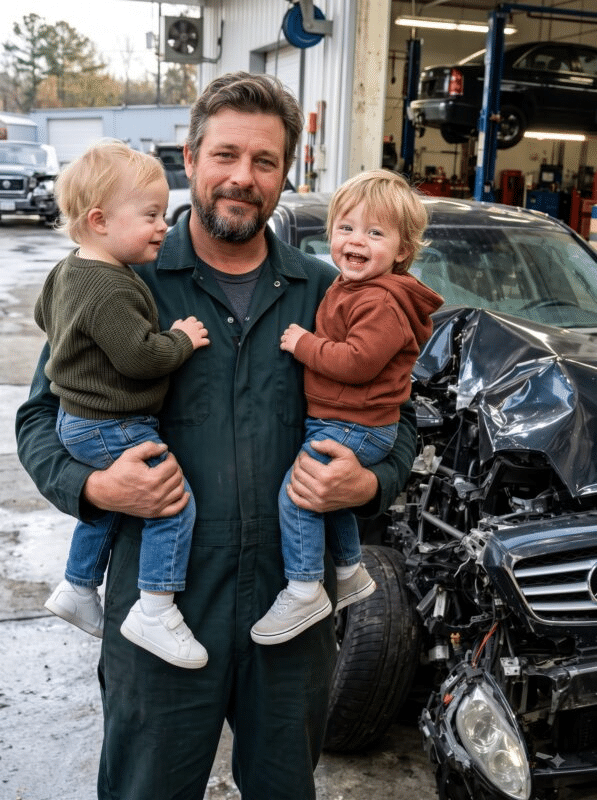
The hood was crushed inward like someone had folded it in half. The driver’s side headlight dangled by its wiring, swinging with every bump. The front bumper was cracked nearly in two, and the left front wheel sat at an angle that told me the damage went a lot deeper than the paint.
Laura climbed out, wearing big sunglasses and the kind of coat that probably cost more than my monthly rent. She walked straight into my office without knocking and tossed the keys onto my desk. They slid across the metal and landed in my lap.
“I need it by Friday.”
I looked through the office window at the car, then back at her.
“Friday?”
“Yes.”
“Laura, that’s a week’s work. At least. Maybe more, depending on what’s going on with that suspension.”
“Then you’ll have to work faster.”
“I already have three cars booked this week. People who’ve been waiting.”
She shrugged, like I’d told her it might rain.
“Move them.”
I stared at her.
“You want me to cancel paying customers so I can fix your car?”
“I need my car, Craig.”
“So do my customers.”
Her jaw tightened. She took off her sunglasses, folded them, and slipped them into her pocket. Then she leaned one hip against the edge of my desk, close enough that I could smell her perfume, the same one she’d worn when we were married.
“Rick and Noah are supposed to stay with you this weekend, aren’t they?”
Everything in me went still.
“Don’t,” I said.
She tilted her head, all innocence.
“Don’t what?”
“Don’t bring the boys into this.”
“I’m not bringing them into anything.”
“You just did.”
She picked up a pen from my desk and turned it slowly between her fingers. She studied it like it was the most interesting object in the room. Then she set it back down, lined up neatly beside my notepad.
“It would just be a shame,” she said softly, “if something came up this weekend.”
I felt heat climb up my neck and into my face.
“You’d keep my children from me,” I said slowly, “over a car repair?”
Her expression barely moved.
“Don’t make me prove it.”
There it was.
For two years she’d hidden behind excuses. Tired kids. Birthday parties. Sniffles. This time, there was nothing between us but the truth, and she laid it right there on my desk next to the keys.
My weekend with my sons had a price. And the price was her Mercedes.
For a few seconds, I couldn’t speak. I looked past her through the glass at that crumpled car, then at the calendar on my wall where I’d written BOYS in thick black marker across Saturday and Sunday.
Noah had been asking all week if we could go to the science museum. Rick wanted to finally beat me at the racing game he’d been practicing.
“Fine,” I said.
Laura smiled, and it was the smile of someone who’d never once doubted how this would end.
“I knew you’d understand.”
She walked out. The door swung shut behind her.
I didn’t understand. Not really.
I just knew I couldn’t risk losing time with my kids over a car.
Part Four: The Week That Almost Broke Me
For the next five days, that Mercedes swallowed my life whole.
The first thing I did was the worst part. I sat at my desk with a cup of burned coffee and called every customer on my schedule to tell them I needed to push their appointments.
Mrs. Delgado, who’d been bringing me her minivan since the week I opened, said she understood, but I could hear the disappointment in her voice. A contractor named Phil, whose work truck was his entire livelihood, cursed me out for a solid two minutes before hanging up. Another guy, a young father with a leaking radiator, told me flatly that he’d take his business elsewhere and never come back.
I didn’t blame any of them. I would have said the same thing.
By Wednesday, fixing Laura’s car wasn’t just costing me time. It was starting to cost me the business itself. The business she’d always said I’d never be able to build.
The damage was worse than it looked, and it looked terrible. When I got the front end apart, I found a bent control arm, a cracked radiator support, and a damaged tie rod. Every new problem meant another part to order and another bill I had to front.
And of course Laura wanted factory replacements. Nothing aftermarket. Nothing “cheap.” So I ordered original parts on credit from my supplier, watching the balance climb higher and higher on an account I had spent two years carefully keeping at zero.
I worked until midnight on Tuesday. Then again on Wednesday. I slept four hours a night and dreamed about torque specs.
On Wednesday evening, Miguel came back after his dinner break and found me sitting on the concrete floor beside the Mercedes, eating a sleeve of crackers from the vending machine because I’d forgotten to eat lunch. Or breakfast.
He stood over me for a moment, wiping his hands on a rag.
“You know she should be paying rush rates for this,” he said.
“I know.”
“And you’re not charging her rush rates.”
“No.”
He looked at me for a long second. Miguel didn’t talk much, but when he did, he usually hit the nail right on the head.
“This about your kids?”
I let out a tired laugh.
“Isn’t it always, with her?”
Miguel sighed and lowered himself onto an overturned bucket beside me.
“Man.” He shook his head slowly. “She knows you’ll do anything if she puts those boys in the middle.”
I didn’t answer.
I didn’t have to. We both knew he was right.
Part Five: Seven Thousand Dollars
By Friday afternoon, the Mercedes looked like it had never been in an accident at all.
I’ll be honest: I was proud of that work. The panels lined up perfectly. The paint matched the factory code exactly, blended so smoothly you couldn’t tell where old ended and new began. The alignment was dead on. I took it for a test drive and it handled like it had just rolled off the showroom floor.
Then I sat down and wrote up the invoice.
The final total was $7,000.
That number is still burned into my memory.
Parts. Labor. Paint. Alignment. Every line item listed and explained, with receipts stapled behind it.
And here’s the thing: it should have been more. I cut my own labor rate well below what I charge anyone else. Some stupid, stubborn part of me still wanted Laura to drive away without another fight. I think some part of me still hoped that if I was decent enough, fair enough, she might finally stop treating me like an enemy.
That hope lasted about ten minutes after she arrived.
She pulled in at four o’clock sharp in Brent’s Range Rover, with Brent behind the wheel. He climbed out in a crisp quarter-zip sweater and loafers that had never touched motor oil in their life. He didn’t say hello. He just started walking a slow circle around the Mercedes, hands clasped behind his back, like a judge at a dog show.
Laura stood beside him with her arms crossed.
I walked over and handed her the invoice.
“Everything’s itemized. Parts receipts are attached.”
She didn’t look at it. She passed it to Brent without taking her eyes off the car.
Brent crouched down near the left front fender and squinted.
“This panel gap looks uneven.”
“It isn’t,” I said. “It’s within factory tolerance. I measured it twice.”
He stood up and dragged one finger slowly along the fresh paint of the hood. He examined his fingertip.
Then, without a word of warning, he reached over and wiped that finger across the front of my work shirt.
“There,” he said. “Dust.”
I looked down at the faint gray streak across my chest.
Something ugly and hot moved through me. For a second, I pictured every possible thing I could say or do. Then I thought of Rick and Noah, and I stayed exactly where I was.
Laura stepped closer to the hood and made a face.
“The paint looks cheap.”
“It matches the factory code exactly.”
“It doesn’t look right.”
I knew what they were doing. Honestly, I think I’d known from the moment they stepped out of that Range Rover. Every complaint was a brick, and they were building a wall.
Brent finally glanced at the invoice. His eyes went to the bottom line, and he laughed. A real laugh, loud and delighted, like I’d told him a great joke.
“Seven grand? For this?”
“The parts weren’t free, Brent. Your wife wanted factory replacements.”
He held the paper out at arm’s length between two fingers. Then he opened his hand and let it drop.
It fluttered down and landed on the oil-stained concrete between us.
“We’re not paying this.”
My pulse was pounding so loudly in my ears that it almost drowned him out.
Laura looked at me and smiled. It was a small, satisfied smile.
“Consider the experience your fee,” she said.
Brent chuckled.
I bent down slowly and picked up the invoice. I smoothed it flat against my thigh.
“You brought me a wrecked vehicle,” I said, keeping my voice level. “You told me to fix it. You authorized the repairs.”
“I didn’t authorize seven thousand dollars,” Laura said.
“You told me to fix it, Laura. By Friday.”
She raised one eyebrow.
“Prove it.”
That word should have terrified me. A week ago, it would have.
But instead, standing there with Brent’s finger smudge on my shirt and the invoice in my hand, that word settled something inside me. It clicked into place like the last bolt on a wheel.
Prove it.
All right, then.
Laura leaned in close so only I could hear her.
“And before you start causing problems,” she murmured, “remember this weekend.”
For once in my life, I didn’t argue with her.
I just smiled.
“Okay.”
Part Six: The Second Sentence
The look on Laura’s face shifted. Just slightly. She’d been braced for a fight, and I hadn’t given her one.
Brent grinned and clapped his hands together.
“Good. Glad you’re being reasonable.”
“I just need your signatures before you take the car,” I said.
His grin flickered.
“For what?”
“My insurer requires written confirmation that the owner inspected the completed repairs and accepted delivery of the vehicle. Standard paperwork. I have every customer sign it.”
That was true. Every word of it.
I walked into my office, pulled a single sheet from the folder in my desk drawer, and set it on the desk with a pen beside it.
The form wasn’t long. At the top, it listed the vehicle, the VIN, the date, and my shop’s name. Below that were two sentences in plain, ordinary type.
The first sentence said that the undersigned had inspected the completed repairs and accepted the vehicle in satisfactory condition.
The second sentence said that the undersigned acknowledged the repairs had been requested by the vehicle owner, and that the invoiced balance of $7,000 remained due and payable to the shop.
Brent grabbed the pen first. He didn’t read the form. He didn’t even glance at it. He was already looking at his phone with his other hand, scrolling through something, when he scrawled his name across the first line.
Laura took the pen from him and signed right underneath. Her signature was the same looping script I’d seen on birthday cards and permission slips for eleven years.
Then she pushed the paper back across the desk toward me with two fingers, like she was sliding away a dirty plate.
“Are we done?”
“We’re done,” I said.
I handed her the keys.
They walked out together, and I heard Brent say something I didn’t catch. Laura laughed. Then the Mercedes purred to life, perfectly tuned, and they drove away, Brent following in the Range Rover.
Miguel had been watching the whole thing from under the hood of a pickup truck. He wandered over to the office doorway.
“You just let them walk?”
I held up the signed form.
“Not exactly.”
He leaned in and read it. Then he read it again. A slow smile spread across his face.
“They didn’t read it.”
“No,” I said. “They didn’t.”
“Man.” He shook his head, but this time, he was grinning. “They’re gonna figure that out.”
“I know,” I said. “Soon enough.”
Part Seven: 5:03 A.M.
At 5:03 the next morning, my phone vibrated so hard it nearly walked itself off the nightstand.
Laura’s name lit up the screen.
I barely got the phone to my ear before she started screaming. It was so loud I had to hold it away from my head.
“Craig! How could you do this to me?”
I sat up in bed and rubbed my eyes.
“What are you talking about?”
“The Mercedes! Brent just read that paper!”
So he’d finally gotten to the second sentence. I pictured him at their big marble kitchen island at five in the morning, coffee in one hand, that sheet of paper in the other, reading it for the first time and slowly going pale. I imagined he had probably wanted to look at it again so he could laugh at me some more.
“You tricked us!”
“No, I didn’t,” I said calmly. “You signed a document confirming that you inspected and accepted the car, and that the $7,000 balance was still owed.”
“You said it was for your insurance!”
“I told you exactly what it was. It confirms the inspection and the delivery. It was right in front of you. You chose not to read it.”
For a moment, all I could hear was her breathing, fast and ragged.
Then her voice dropped low. Dangerous.
“Stop whatever you’re doing, Craig.”
“You owe my shop seven thousand dollars.”
“We are not paying you.”
“Then I’ll handle it the same way I’d handle any other customer’s unpaid bill.”
Silence stretched across the line.
Then Laura reached for the one thing she had always been able to use against me. I could almost hear her pick it up.
“Rick and Noah are supposed to come to you tonight, aren’t they?”
My hand tightened around the phone until my knuckles hurt.
“Don’t.”
“Drop this, Craig.”
“The boys have nothing to do with your repair bill.”
“They do,” she said, “if you make them.”
The line went dead.
Part Eight: The Pizza Went Cold
I went to work that day, but I don’t remember much of it. I changed oil. I rotated tires. I apologized to two more customers whose appointments had been pushed. Mostly, I watched the clock.
When I got home that afternoon, I did everything I always did before a weekend with my boys. I refused to let Laura take that from me, too.
I bought the chocolate cereal Noah liked, the one I pretended to disapprove of. I put fresh sheets on Rick’s bed, the ones with the faded racing stripes he claimed he’d outgrown but never let me throw away. I set the racing game up on the TV. At a quarter to six, I called in our usual Friday night order: one large pepperoni, one plain cheese because Noah went through phases, and a side of garlic knots.
Then I sat on the couch and waited to find out whether Laura had meant what she’d said.
Six o’clock came.
Then six fifteen.
The pizza arrived at six twenty-five. I set the boxes on the kitchen counter and didn’t open them.
Six thirty.
At seven, I finally picked up my phone and texted her.
Where are the boys?
She let me wait ten minutes. I know she did it on purpose. Then her reply came through.
Plans changed 🤷 They’re staying here.
I stared at that little shrugging emoji for a long time.
I started typing. You can’t do this. It’s my weekend. The court order says…
Then I stopped and deleted it.
For two years, I’d argued with her every single time she pulled something like this. I’d begged. I’d reasoned. I’d gotten angry. None of it had ever gotten me anywhere. It had only taught her that I would fold eventually.
So this time, I typed one simple question and sent it.
Why are you keeping the boys on my weekend?
Her answer came back in less than a minute.
Drop the claim over the Mercedes, and maybe we can discuss next weekend.
I read it once.
Then I read it again, slowly, word by word.
For two years, Laura had always been careful to leave herself an escape hatch. The boys were tired. The boys were sick. The boys had plans. There had always been a story she could tell a judge, a lawyer, a friend, anyone, that made her sound reasonable and made me sound like a bitter ex-husband who couldn’t let go.
This time, she hadn’t bothered with a story.
She’d put it in writing.
Drop the claim, and maybe you’ll see your kids.
For the first time since the divorce, I wasn’t going to have to convince anyone of what Laura meant. I wasn’t going to have to explain her tone or describe the way she tilted her head or try to make someone understand the weight behind “Do you really want to make this difficult?”
I could just show them.
I actually smiled.
Then I looked up at the unopened pizza boxes on the counter, at the racing game waiting on the screen, at the dark hallway leading to two empty bedrooms. My eyes started to burn.
I finally had proof.
I just hated what it had cost me to get it.
I took a screenshot of the message. Then another one, just to be safe. Then I sat in my kitchen and ate one cold slice of pepperoni pizza, alone, and it was the worst meal I’ve ever had.
Part Nine: Everything, Exactly as She Wrote It
On Monday morning, I called my attorney, a soft-spoken man named Howard who had handled my divorce and who had told me more than once that I was letting Laura get away with far too much.
I told him everything. The Mercedes. The threat in my office. The canceled customers. The signed form. The 5 a.m. phone call. The empty weekend.
When I finished, he was quiet for a moment.
“Send me that text message,” he said. “Exactly as she wrote it. Don’t crop it. Don’t add anything.”
I sent it while we were still on the phone. I heard him exhale slowly on the other end.
“All right,” he said. “Now I want everything else.”
“Everything?”
“The repair records. The parts receipts. That signed form. And every message she’s ever sent you about changing the custody schedule. Every single one. Going back as far as you have them.”
It turned out I had a lot of them. Two years of The boys are tired and Something came up and Maybe next time. I’d saved them all without really knowing why. Maybe some part of me had always hoped this day would come.
A few weeks later, we were sitting in family court.
Laura wore a navy dress and pearl earrings and sat very straight beside her attorney. Brent sat in the row behind her. He didn’t look at me.
When it was her turn to speak, Laura tried to make it all about the car.
“Craig is angry because we questioned the quality of his work,” she said, her voice soft and wounded. “We had legitimate concerns about the repairs. And now he’s using the children to pressure me into paying a bill I don’t think is fair.”
For a moment, hearing her twist it that way made my stomach clench. It was exactly what she had always done. She’d take the very thing she’d threatened me with and turn it around until I was the one who looked like the problem.
Then Howard stood up and handed the court the messages.
The room became very quiet.
Laura’s attorney glanced down at the printouts. His expression didn’t change much, but he leaned over and whispered something in her ear. Her face went still.
Howard walked through the sequence, calm and methodical, one step at a time.
Laura brought a badly damaged Mercedes to my shop and demanded I set aside other paying customers to repair it by Friday.
When I resisted, she threatened my scheduled weekend with our sons.
I did the work anyway. Six days. Thousands of dollars in parts purchased on credit.
She and her husband inspected the car, signed a form accepting it and acknowledging the balance owed, and then refused to pay.
I began treating the $7,000 like any other unpaid business debt.
And within hours, Laura withheld my parenting time and put the reason in writing.
Then Howard handed the judge the final message.
Drop the claim over the Mercedes, and maybe we can discuss next weekend.
The judge read it. Then she looked up at Laura over the top of her glasses and held that look for a long, long time.
Laura shifted in her chair.
For once in her life, she didn’t have another explanation ready.
And I noticed something else. Brent had stopped staring at the floor. He was staring at the back of his wife’s head, like he was seeing her for the very first time.
Part Ten: Not Hers to Take
The court enforced my parenting time and awarded me make-up weekends for every weekend Laura had withheld.
The order also made one thing absolutely unmistakable, in language even Laura couldn’t twist. My time with Rick and Noah was not hers to hand out as a reward or take away as a punishment. It was not a bargaining chip for car repairs or anything else. Any further interference would carry real consequences.
I sat there reading those words and felt something loosen in my chest that had been knotted for two years.
Outside the courtroom, I was heading for the elevator when I heard Brent’s voice behind me.
“Laura. Wait.”
She stopped. He caught up with her a few feet from where I stood.
“You really kept his kids from him over that bill?” He kept his voice low, but the hallway was quiet, and it carried. “I thought you were bluffing. I thought that was just talk.”
“Stay out of it, Brent.”
She turned and looked at me over his shoulder, and her eyes were hard.
“This is what you wanted, isn’t it?”
Before I could say anything, Brent shook his head.
“Don’t blame him.” He rubbed the back of his neck. “I laughed when we left that shop. I wiped my hand on the guy’s shirt, Laura. I thought it was funny.” He let out a breath. “I shouldn’t have done any of it. And I definitely wouldn’t have if I’d known you were serious about the boys.”
Laura stared at him like he’d slapped her.
“So you’re taking his side now?”
“This isn’t about sides,” Brent said quietly. “It’s about what you did.”
The elevator doors slid open with a soft chime.
I stepped inside and pressed the button for the lobby, and I left them standing there in the hallway, facing each other, with nothing left to say that I needed to hear.
Part Eleven: Square
The repair bill remained a separate matter.
I didn’t threaten them over it. I didn’t bargain with Laura or offer to drop it in exchange for anything. I didn’t mention it in family court beyond what was necessary to explain the timeline. I simply kept the signed paperwork in my files and let my shop’s normal collection process run, exactly the same way it would for any other customer who drove away without paying.
They fought it, of course. Brent hired a lawyer who sent me a long letter full of words like “coercion” and “misrepresentation.”
My lawyer sent back a copy of the form. Two sentences. Plain type. Two signatures.
They still had to pay.
The day the money cleared, I sat at my metal desk with the leaky coffeemaker dripping beside me and paid off every dollar I owed my parts supplier. I called Mrs. Delgado and told her the next oil change was on me. I even left a message for Phil the contractor, apologizing again and offering him a discount if he ever wanted to come back. To my surprise, he did.
Then I went back to work.
I thought I would feel victorious. I’d imagined that moment for weeks.
But I didn’t feel victorious.
I felt square. Like a ledger that had finally been balanced.
After that, Laura stopped calling me with demands. The late-night calls and the veiled threats and the “Do you really want to make this difficult?” all simply stopped. When she needed to talk about the boys, she sent short, careful text messages. Noah has a dentist appointment Thursday. Rick needs cleats. Polite. Businesslike.
I answered the same way.
Part Twelve: They Were There
The first restored weekend, I closed the shop at four o’clock on a Friday. Miguel waved me out the door.
“Go,” he said. “I’ve got it.”
I drove to Laura’s house with my heart hammering like I was sixteen and picking someone up for a first date.
Rick and Noah were already waiting on the front steps with their backpacks.
Noah saw my truck and took off running before I’d even put it in park.
“Dad! Dad!“
I barely got my door open before he slammed into me and wrapped both arms around my waist, squeezing so hard I nearly lost my balance.
Rick followed at a slower pace, trying very hard to look eleven and unbothered. He made it about halfway across the lawn before he gave up and hugged me too, his face pressed against my shoulder.
“Missed you, Dad,” he mumbled.
“Missed you too, buddy. So much.”
On the drive home, Noah talked nonstop about a science project involving baking soda and a papier-mâché volcano that had apparently exploded all over his classroom. Rick complained bitterly about a teacher who had the nerve to assign homework over a weekend. Then they got into a full-blown argument over the radio station, the same argument they’d been having since Noah was old enough to have an opinion.
I didn’t mind a second of it.
At a red light, I glanced up into the rearview mirror.
There they were. Noah with his hair sticking up in the back. Rick with his arms crossed, pretending to be annoyed but fighting a smile.
They were there.
That was all I had ever cared about.
Part Thirteen: What Fear Can’t Do Forever
For years, Laura understood one thing about me better than anyone else in the world.
She knew I would accept almost anything if I thought refusing might cost me my sons.
She knew I’d cancel customers. She knew I’d go into debt. She knew I’d let a man wipe his dirty finger across my chest and say nothing. She knew I’d swallow every insult and every broken weekend, because the thought of losing my boys scared me more than anything else ever could.
And for a long time, she was right.
The mistake she made was believing that fear would work forever.
It didn’t.
I didn’t beat her by humiliating her. I didn’t set out to destroy her marriage or embarrass her in front of her new husband. I didn’t need revenge. If I’m honest, I didn’t even want it.
All I did was stop protecting her from the consequences of her own choices.
I stopped absorbing the cost of her cruelty and let it land where it belonged. I stopped arguing and started documenting. I stopped begging and started asking simple questions, and let her answer them in her own words.
And once I did that, the threat that had controlled me for two long years finally became what it had always been underneath.
Nothing more than words.
Now, every morning when I unlock the door of my shop, I don’t hear Laura’s voice anymore. I don’t hear You’re going nowhere in life.
I hear the roll-up door groan. I hear Miguel’s radio. I hear the coffeemaker dripping onto the floor.
And on the weekends, I hear two boys arguing about the radio in the back of my truck.
Turns out I wasn’t going nowhere after all.
I was just going somewhere she couldn’t follow.
[This story is a work of fiction inspired by real events.]

One thought on “My Ex-Wife Threatened to Take My Sons Unless I Fixed Her Wrecked Mercedes by Friday—When She and Her Rich New Husband Laughed and Refused to Pay the $7,000 Bill, I Just Smiled and Did the Last Thing They Expected”