

I Married a Dying Man Because…..
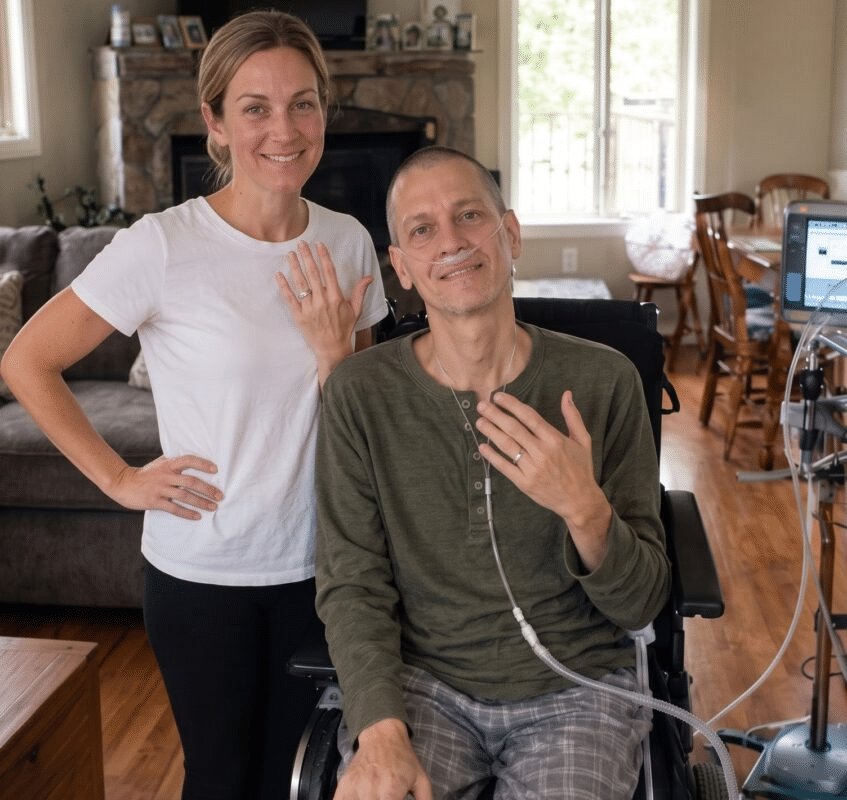
I volunteered with hospice three times a week. Julian was 40, dying, and completely alone. One afternoon over tea, he asked me to marry him so he wouldn’t die alone—and I said yes, in a white T-shirt in his living room. Ten days later, he was gone. After the funeral, his lawyer handed me a letter. The second line brought me to my knees.
Part 1: The Knock : I Married a Dying Man Because
I buried my husband on a Friday.
We had been married for ten days.
On Saturday morning, I was sitting on my kitchen floor in Dayton, Ohio, still in the black dress I’d bought at Kohl’s for $38. I hadn’t even taken the tag off. I kept telling myself I’d return it.
At 10:40 a.m., someone knocked on my door.
Three knocks. Slow. Polite.
I almost didn’t answer. My landlord had been texting me about the new lease, the one where my rent went from $1,150 to $1,295 a month, and I didn’t have the energy to talk about money.
But the knocking came again.
When I opened the door, a man in his sixties stood on my welcome mat. Gray suit. Tan raincoat folded over his arm. He held a brown leather briefcase with both hands, the way people hold something they’ve promised not to drop.
“Mrs. Claire Mercer?” he asked.
It took me a second to realize he meant me. I had been Claire Hale for thirty-four years. I had been Claire Mercer for less than two weeks.
“Yes,” I said. “That’s me.”
“My name is Arthur Vance. I was Julian’s attorney.” He paused. “I’m very sorry for your loss.”
“Thank you. If this is about the funeral home bill, I already—”
“It isn’t.” He took a breath. “Julian made me wait until today to tell you the truth about who he really was.”
I stared at him.
“He was very specific,” Arthur said. “Not before the wedding. Not before he passed. Not at the funeral. The day after. He said you’d need one night to grieve him the way you knew him.”
He opened the briefcase and handed me a cream-colored envelope. My name was written across the front in Julian’s handwriting. I knew that handwriting. He used to keep score on the back of receipts when we played Scrabble, and he always wrote my name first.
Claire.
“Once you read the letter,” Arthur said quietly, “you’ll understand everything.”
I opened it right there in the doorway.
The first line said:
Our meeting was not an accident. I’ve known you your entire life, and I’ve quietly watched over you.
My fingers went cold.
Then I read the second line.
And my legs simply stopped holding me up.
To understand why, you have to know how I met Julian. And you have to know what I believed about my life before that letter took it apart.
Part 2: Tuesdays, Thursdays, and Saturdays
I was three years old when my mother died.
That’s the sentence I grew up with. It was the first line in every file a social worker ever opened on me. Mother deceased, 1995. Father unknown. No relatives able to take placement.
I don’t remember her face without the help of one photograph. In it, she’s twenty-four, wearing a bright orange safety vest, laughing at whoever took the picture. Her name was Diane Hale. I was told she died in “a traffic accident on her way to work.” That was all anyone ever said. Nobody seemed to know more, and after a while, I stopped asking.
I lived in four foster homes before I turned eighteen. Two were kind. One was fine. One I don’t talk about.
There was only one thing in my childhood that never changed.
Every year on my birthday, March 9th, a card arrived. No return address. Inside, there was always a $50 bill and the same short message, written in neat block letters:
Your mother would be proud of you. — A Friend
My caseworkers assumed it was a church program. My foster mothers assumed it was a relative who didn’t want responsibility. I assumed it was a mistake that would eventually stop.
It never stopped. Not once in fifteen years.
When I aged out of foster care, the cards ended. But that same summer, I received a letter from a community foundation telling me I’d been selected for something called the D.H. Opportunity Grant. Two thousand dollars. No application needed.
That money paid for my certified nursing assistant course.
That’s what I’ve done ever since. I’m a CNA at an assisted living facility on the east side of town. I work 7 a.m. to 3:30 p.m., five days a week. I help people shower, eat, walk, and remember their children’s names.
I’m good at it. I’m good at taking care of people.
What I’m not good at is letting people take care of me.
My dream—my real one—was to finish nursing school. I’d started a program at twenty-two and dropped out after two semesters when my car died and I had to choose between tuition and getting to work. At thirty-four, I had $3,212 saved. The program at Sinclair would cost about $14,000 by the time I finished, plus the hours I’d lose at work.
So I did what I always did. I worked. I saved. I told myself “next year.”
Three times a week—Tuesdays, Thursdays, and Saturdays—I volunteered with a hospice support program. Light housekeeping. Meals. Company. The coordinator, Denise, once asked me why I gave up so much of my free time.
I gave her the easy answer. “I like being useful.”
The true answer was harder to say out loud: I didn’t want anyone to leave this world the way my mother had—suddenly, with nobody holding her hand.
In late June, Denise called me into her office.
“New patient,” she said, sliding a folder across the desk. “Julian Mercer. Forty years old. Stage four pancreatic cancer. Lives alone on Linden Street. No family listed except a sister, and she’s marked ‘do not contact.’”
“Forty,” I said. “That’s young.”
“It is.” Denise hesitated. “There’s one odd thing. He requested you. By name.”
“Me? I don’t know anyone named Julian.”
“He said a friend recommended you.” She shrugged. “People talk. You’ve got a good reputation.”
I believed her.
I had no reason not to.
Part 3: The Proposal
Julian’s house was a small yellow two-story with a porch swing that squeaked on the left side. The first time I knocked, he opened the door wearing a gray Ohio State hoodie that hung off him like a blanket on a chair.
He was thin in the way only sick people are thin. But his eyes were warm and quick, and when he smiled, he looked like someone who’d been waiting for a friend.
“Claire,” he said. Not a question.
“Hi. I’m with the hospice program. I brought chicken noodle soup, but I didn’t know if you—”
“Soup’s perfect.” He stepped aside. “Come in. Fair warning, I’m terrible at dusting.”
He wasn’t lying.
That first week, I cleaned his kitchen, sorted a mountain of mail, and learned that he’d been an accountant until the diagnosis. He’d never married. He liked old movies, crossword puzzles, and Scrabble, which he played ruthlessly.
“You can’t play ‘QI,’” I told him on my third visit.
“It’s in the dictionary.”
“It’s not a real word.”
“It’s a real word in Chinese philosophy and in my heart,” he said, adding up his score on the back of a CVS receipt. “Thirty-one points. Your move, Hale.”
I laughed so hard I nearly knocked over my tea.
That was the thing about Julian. The house was quiet and full of pill bottles, and yet I laughed there more than I had in years.
There were small things I noticed. Things I didn’t think about until much later.
The first time he made tea for me, he didn’t ask how I took it. He brought me chamomile with one spoonful of honey and a splash of milk.
That was exactly how I drank it. Almost nobody makes chamomile with milk.
“How did you know?” I asked.
He looked down at his cup. “Lucky guess. It’s how my mom used to make it.”
Another time, while I was washing dishes, I caught him humming “You Are My Sunshine.” Not the usual way—slower, with a little pause before you’ll never know, dear.
I stopped with a plate in my hands.
I’d hummed that song exactly that way my whole life. I had no idea where I learned it. One of my caseworkers once told me it might have been a memory of my mother.
“Where’d you learn it like that?” I asked.
Julian’s humming stopped. “Somebody used to sing it to me when I was a kid,” he said. “On my way to school.”
Then he changed the subject to the Reds’ bullpen.
By August, I was coming more than three times a week. Denise didn’t love that, but she didn’t stop me either. Julian’s pain was getting worse. His hospice nurse, a brisk woman named Tanya, told me privately that he probably had weeks, not months.
One rainy Thursday afternoon, we were halfway through a Scrabble game. He’d just played “HOME” on a triple word score. He didn’t write the points down. He just looked at the tiles for a long moment.
Then he looked at me.
“Marry me,” he said.
I actually laughed. I thought it was a joke.
He didn’t laugh.
“I know how this sounds,” he said. “I’m not confused. I’m not on too much morphine. I’ve thought about this for a long time. I’d like to die knowing I’m not alone.”
“Julian.” I set my tiles down. “We haven’t known each other very long.”
“I know. But it’s been long enough for me to understand what kind of person you are.” His voice cracked on the last word. “It would mean everything to me. It’s the one thing I’d like to do before I die.”
I should have said no.
Every sensible part of me said no. So did Denise, when I told her the next morning.
“Claire, you can’t,” she said. “It’s against every volunteer policy we have. If you do this, I have to remove you from the program. Today.”
“I understand.”
“And people will talk. A dying man with a house, and a volunteer who marries him? Do you know what that looks like?”
I knew exactly what it looked like.
“He doesn’t have anyone,” I said. “He asked me for one thing.”
Denise took my volunteer badge. She hugged me before I left, but she still took the badge.
I don’t know how to explain what I felt. It wasn’t romance, not the way movies show it. It was something quieter. Like I’d found a person I’d somehow been missing without knowing it.
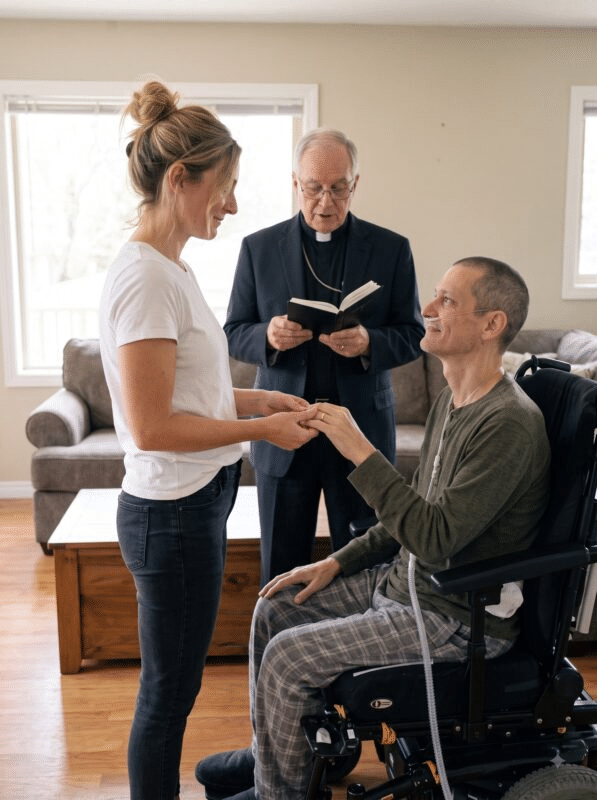
The next afternoon, a retired Methodist minister named Reverend Paul Kessler came to Julian’s house. Tanya and a neighbor named Mrs. Ortiz served as witnesses.
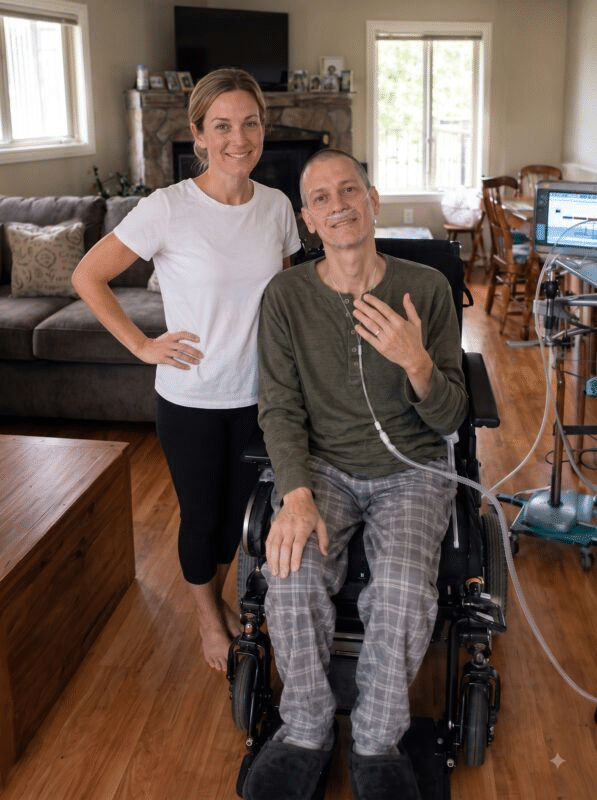
I wore jeans and a plain white T-shirt. It was the only white thing I owned.
There were no flowers. No music. Just the rain on the porch roof and Julian in his recliner, sitting as straight as he could manage.
When Reverend Kessler said, “You may now kiss the bride,” Julian kissed my hand instead. His fingers were shaking.
“Thank you,” he whispered. “You have no idea what you just gave me.”
I thought I understood.
I didn’t understand anything.
Part 4: Ten Days
Those ten days were the strangest and most tender days of my life.
I moved into Julian’s guest room with one duffel bag. I slept with the door open so I could hear him if he called. I learned how to adjust his pain pump. I learned which mug he liked—a chipped blue one from a gas station in Kentucky.
And I learned that Julian had secrets.
On the third day, I was looking for extra blankets in the hall closet when I found a cardboard box on the top shelf. Written on the side in black marker were two letters:
D.H.
Before I could open it, Julian called my name from the living room. His voice was sharper than I’d ever heard it.
“Claire. Not that one. Please.”
I put it back. “I’m sorry. I was just looking for—”
“I know.” He closed his eyes. “It’s not that I don’t want you to see it. It’s that I want you to see it at the right time.”
“What does D.H. stand for?”
He didn’t answer.
I told myself it was probably an old girlfriend. Someone he’d loved and lost. It would explain why he’d never married. It would explain why he was so desperate not to die alone.
That was the story I chose to believe. It made sense.
It was wrong.
On the fifth day, a woman showed up on the porch.
She was around forty-five, with Julian’s dark eyes and a Kroger employee badge still clipped to her jacket. She didn’t knock. She just stood on the steps with her arms crossed until I opened the door.
“So you’re the wife,” she said.
“I’m Claire.”
“Marissa. His sister.” She looked me up and down—my messy bun, my scrubs from work. “Arthur told me he got married. To a hospice volunteer he met in June.”
“Would you like to come in? He’s awake. He’d—”
“Does he know what this looks like?” Marissa asked. “Because I do. My little brother is dying, and a stranger marries him ten minutes before the end. I work thirty-eight hours a week and raise two kids alone, and I’m the one who gets told ‘do not contact’?”
Before I could answer, Julian’s voice came from behind me.
“Mari.”
He was standing in the hallway, gripping the wall. I hadn’t seen him on his feet in two days.
Marissa’s whole face changed. For one second, she didn’t look angry. She looked like a little girl.
“You look terrible, Jules,” she said.
“I feel worse.” He almost smiled. “Please don’t blame her. She doesn’t know anything. That’s my fault.”
“Know what?” I asked.
Neither of them looked at me.
Marissa stayed for twenty minutes. I gave them the living room and sat on the porch swing, listening to it squeak. When she left, her eyes were red. She walked past me without a word, then stopped at the bottom of the steps.
“He gave up his whole life for your family,” she said quietly. “I hope you know that.”
Then she got into a silver Honda Civic and drove away.
My family?
I didn’t have a family.
That night, Julian was too weak to eat. I sat beside the hospital bed Tanya had set up in the living room, and I asked him what his sister meant.
He took my hand.
“Claire, I need you to promise me something,” he said. “Someday soon, you’re going to learn something that might make you hate me.”
“I could never—”
“Just promise me. When you find out, read to the end. Don’t stop halfway. Okay?”
“Okay,” I whispered. “I promise.”
Julian died five days later, at 4:12 in the morning, with the porch light on and my hand in his.
The last thing he said to me, so softly I almost missed it, was:
“You were worth it, Claire. Every single year.”
I didn’t know what he meant.
Not until Arthur Vance knocked on my door.
Part 5: The Second Line
Arthur caught my elbow before my head hit the doorframe.
I don’t remember how I ended up at my own kitchen table. I just remember Arthur filling a glass of water at my sink as if he’d done this before, and the letter lying flat in front of me.
I read the second line again.
Your mother, Diane Hale, did not die in a random accident. She died on the morning of October 12, 1995, because she pushed a nine-year-old boy out of the path of a car.
I was that boy.
I put my hand over my mouth.
Arthur sat down across from me and said nothing. He let me read.
She was the crossing guard at Kemp Elementary. Every morning, she said, “Good morning, Mr. Julian,” like I was somebody important. She sang “You Are My Sunshine” to the kids while we waited for the light. She sang it slow, with a little pause, because she said the pause was where the love went.
She showed me pictures of you. Her baby girl with the curly hair. She said you were the reason she took the early shift, so she could finish her nursing classes at night and give you a better life.
On October 12th, my soccer ball rolled into the street. I ran after it. I didn’t look. A man ran the red light on Smithville Road. Your mother didn’t hesitate.
I lived. She didn’t.
I’ve spent thirty-one years trying to figure out how to deserve that.
I couldn’t breathe.
Everything was rearranging itself in my head. The chamomile with milk—my mother’s way, which she must have described to a little boy on a cold morning. The song. The pause. The box marked D.H.
Diane Hale.
I kept reading.
My parents wanted to adopt you. I need you to know that. They tried. But your mother had listed a cousin in Indiana as your guardian, and by the time the courts sorted out that the cousin couldn’t take you, you were already in the system, and my father had started drinking. Our family fell apart under the weight of what happened. My parents divorced two years later.
When I was twelve, I found your foster placement address in my mother’s desk. I mowed lawns all summer. That was the first $50 card.
I was the Friend, Claire.
When I got my first real job, I set up the D.H. Opportunity Grant through a local foundation. It had exactly one recipient.
I found you again three years ago. I learned you worked at Brookhaven. I learned you volunteered for hospice. When I got sick, I asked for you. That was the only lie I ever told you directly. It wasn’t a friend who recommended you.
It was your mother. Every morning, when I was nine years old.
I pushed the letter away and stood up so fast the chair scraped the floor.
“He lied to me,” I said. “For three months.”
“Yes,” Arthur said.
“Did he marry me out of guilt? Was I—” My voice broke. “Was I some kind of debt he was paying off before he died?”
Arthur folded his hands. “I think that’s a question only he could answer. And he tried to.”
He reached into his briefcase and placed three more things on my table.
A USB drive with a sticky note that said: Watch this last.
A copy of Julian’s will.
And the key to the yellow house on Linden Street.
“As his legal spouse,” Arthur said, “you inherit the house, which is paid off and appraised at around $185,000. You’re also the beneficiary of a life insurance policy for $40,000. And the box from the hall closet. He said you’d know which one.”
I stared at the key.
For thirty-four years, I’d wanted a home that nobody could take away from me.
Now one was sitting on my kitchen table, and it felt like it had been paid for with my mother’s life.
“I don’t want it,” I said.
Arthur nodded slowly. “You may want to decide that after you’ve heard from his sister.”
“Marissa?”
“She called me this morning,” he said. “She intends to contest the will. She’s claiming undue influence. She believes you married Julian for his house.”
Part 6: The Sister
I didn’t open the box that night. I didn’t watch the video either.
I was too angry. Angry at Julian for lying. Angry at my mother for being brave. Angry at a man who ran a red light thirty-one years ago and whom I’d never even thought about, because I’d never known he existed.
And underneath the anger, something worse.
For fifteen years, I’d believed a stranger thought I was worth $50 and a sentence on a card. It had kept me going through the worst foster home. It had kept me going the night I aged out with two trash bags of clothes.
Now I knew why.
It wasn’t because I was worth something. It was because a boy felt guilty.
At least, that’s what I believed that night.
On Monday, Arthur arranged a meeting at his office downtown. Marissa arrived ten minutes late, still in her Kroger jacket. She sat on the opposite side of the conference table and didn’t take her coat off.
“I’ll be direct,” she said. “That house was our grandmother’s. My brother moved in to take care of her when she got sick. It was supposed to stay in the family.”
“I understand,” I said.
“Do you?” Her jaw tightened. “Because I’m renting a two-bedroom apartment in Kettering for $1,340 a month with a fourteen-year-old and a nine-year-old. My ex-husband sends child support when he feels like it. And my brother—who never missed a single one of your birthdays—missed three of my daughter’s.”
That landed like a slap.
“I didn’t know he existed until June,” I said.
“I know you didn’t.” She looked at the table. “That’s what makes it so unbearable.”
Arthur cleared his throat. “Marissa, you should know that Julian was of sound mind, and there are witnesses. If you contest this, you’ll likely lose. And it’ll cost you money you don’t have.”
“Maybe,” she said. “But I’m not letting it go without saying something.”
She turned to me.
“You want to know what our family was like after your mother died? My dad couldn’t drive past Smithville Road. My mom kept a newspaper clipping on the fridge for two years until my dad tore it down. Julian stopped playing soccer. He stopped playing anything. He was nine years old, and he decided his life belonged to you.”
“I never asked him to—”
“I know you didn’t!” Her voice rose, then broke. “I’m not angry at you, Claire. I’m angry that my brother spent his whole life paying for something that wasn’t his fault. And I’m angry that when he finally got to the end, he chose you instead of me.”
The room went quiet. Arthur didn’t move. The only sound was the air conditioner humming in the vent.
Marissa wiped her face with the back of her hand. “He told me to stay away, you know. Five years ago. I said something cruel about his ‘charity project.’ I said he was wasting his life on a girl who didn’t even know his name. He told me not to call him until I could say her name without contempt.”
She looked at me for a long moment.
“I still can’t,” she said. “Not yet.”
She left without shaking my hand.
That night, I drove to the yellow house on Linden Street.
I let myself in with Julian’s key. The hospital bed was gone. The recliner was still there, with the dent where he used to sit. The Scrabble board was still on the coffee table. Our last game was frozen mid-play.
HOME. Triple word score. He’d never written down the points.
I sat on the floor, pulled the box marked D.H. into my lap, and opened it.
Inside, folded neatly, was an orange crossing guard vest. Faded almost to peach. The name tag still pinned to it said: DIANE.
Under that was a stack of photographs I’d never seen. My mother at a church picnic. My mother holding a baby—me—on a porch I didn’t recognize. My mother in the crosswalk, one hand raised, a line of kids behind her.
At the bottom was a cassette tape labeled in faded pen: Kemp Elementary Fall Concert, 1995.
And a second copy of every birthday card he’d ever sent me. All fifteen. He’d kept a copy of each, dated, in order.
Under those was a note in Julian’s adult handwriting.
She would have told you these things herself. I just held onto them until you were ready.
I held the vest against my chest and sat in the dark until the streetlights came on.
Then I plugged the USB drive into my laptop.
Part 7: What He Wanted Me to Hear
The video was eleven minutes long.
Julian had recorded it in the recliner. Judging by his face, it was early July—a few weeks after we’d met, before he got too thin to sit up.
“Hi, Claire,” he said, and my throat closed up at the sound of his voice. “If you’re watching this, Arthur did his job, and you’ve read the letter. And you’re probably pretty mad at me.”
He smiled a little.
“You have every right to be. I lied to you. I let you think you were the lucky one who got assigned to me. The truth is, I’ve been the lucky one since I was nine.”
He looked away from the camera for a moment.
“I need to tell you why I asked you to marry me. Because I know what you’re thinking. You think it was guilt. You think I was paying a bill.”
He shook his head slowly.
“I was going to leave you the house anyway, Claire. I didn’t need to marry you for that. Arthur could have written a will in an afternoon.”
I paused the video. I sat there with my hand over my mouth.
Then I pressed play.
“About three weeks ago, you told me something while we were playing Scrabble. You said that in thirty-four years, nobody had ever written your name down as family. Not on a school form. Not on an emergency contact card. Not at a hospital. You said you always left that line blank.”
I remembered saying it. I had said it like a joke.
“I couldn’t stand it,” Julian said. “I couldn’t give your mother back. I couldn’t give you the childhood she wanted for you. But I could make sure that for once in your life, somebody chose you on purpose. Out loud. In front of witnesses. Not because they had to. Because they wanted to.”
His voice was thick.
“It wasn’t guilt that made me ask you. It was the guilt that kept me from asking sooner. The marriage was the one thing I did for you that wasn’t about her. It was about you.”
He coughed, then gathered himself.
“Two more things, and then I’ll let you go.
“First—go finish nursing school. The insurance money is for that. Your mom was two semesters from her RN when she died. I think she’d like it if one of you crossed that line.
“Second—I wasn’t fair to Marissa. I let one bad sentence she said five years ago become a wall. She was hurting too. She lost our dad to that morning just like I did. If she’s angry at you, she’s really angry at me. I’m sorry I left you to deal with that.
“I love you, Claire Hale Mercer. Not the way you love someone in a movie. The way you love the person who proves your life was worth saving.”
The screen went black.
I watched it three times.
Then I made my choice.
It was not an easy one. I want to be honest about that. For three nights, I sat at my kitchen table with a legal pad and did the math.
If I kept the house, I would never pay rent again. I could sell it and have $185,000—more money than I’d ever seen in my life. I could fight Marissa, and Arthur said I’d probably win.
But I kept thinking about three things.
A nine-year-old boy who lost his childhood on Smithville Road.
A fourteen-year-old girl in Kettering whose uncle had missed her birthdays so he could send mine.
And my mother, who didn’t stop to calculate anything when she stepped into that street.
On Thursday evening, I asked Marissa to meet me at the house on Linden Street.
She came in slowly, like she hadn’t been inside in years. Her eyes went straight to the recliner.
“I’m not here to fight,” I said. “I’m here to make an offer.”
She crossed her arms. “Okay.”
“Arthur is drawing up the paperwork to transfer the house to you. It was your grandmother’s. It should be your kids’ now.”
Marissa didn’t move.
“I’m keeping the insurance money,” I said. “Julian asked me to use it for nursing school, and I’m going to. I’m keeping the box, and the vest, and the photographs. And I’d like to keep one thing from this house. The Scrabble board.”
“Why?” Marissa’s voice was barely a whisper. “Why would you do this? You could keep all of it.”
“Because I’m not the only person that morning took something from,” I said. “And because I’m not doing it so you’ll like me. I need you to understand that. You don’t owe me friendship.”
I took a breath.
“But I do have one condition.”
“What?”
“You don’t ever call me his charity project again. Not to me, not to your kids, not to anyone. I was his wife. It only lasted ten days, but it was real.”
Marissa stood very still.
Then she unzipped her Kroger jacket, as if she’d finally decided to stay a while.
“Claire,” she said.
Just my name. Nothing else. No contempt in it.
It was enough.
Part 8: The Pause Where the Love Goes
That was eight months ago.
In January, I started the nursing program at Sinclair Community College. I cut my hours at Brookhaven to thirty a week. The $40,000 covers tuition, books, and the gap in my paychecks. If everything goes as planned, I’ll graduate in May of next year.
My mother was two semesters away. I’m three.
I think she’d forgive me the extra one.
Marissa and her kids moved into the yellow house in November. Her daughter, Lily, is fourteen and has claimed the guest room I slept in. Her son, Ben, is nine. He painted the porch swing blue and fixed the squeak on the left side with a can of WD-40.
I told him not to. I kind of liked the squeak.
He said, “Uncle Julian would’ve wanted it fixed.” And he was probably right.
Denise called me in February. The hospice program had reviewed my situation, and they’d decided to let me come back once I finished school. “Just don’t marry any more patients,” she said.
“I won’t,” I told her. “He was the only one.”
The man who ran the red light in 1995 died in 2011. I found his name in an old newspaper article at the library. I read it once. Then I closed the laptop.
I decided that morning didn’t get to take anything else from me.
Marissa and I aren’t sisters. We aren’t exactly friends yet. But every Sunday at 4 p.m., I drive to Linden Street, and Lily and I play Scrabble at the kitchen table while Marissa makes dinner.
Lily plays “QI” every single time.
“It’s not a real word,” I tell her.
“Uncle Julian said it was real in Chinese philosophy and in his heart,” she says, writing down the score on the back of a receipt.
I have no idea when he told her that. I guess he found a way to be there for her, too, in the end.
Last month, my certified nursing program asked me to fill out an emergency contact form for my clinical rotation.
I sat there with the pen in my hand for a long time.
Then, for the first time in my life, I filled in the line.
Marissa Mercer. Sister-in-law.
When I got home that night, I made myself a cup of chamomile. One spoonful of honey. A splash of milk.
And I hummed “You Are My Sunshine,” slowly, with a little pause before you’ll never know, dear.
Because now I know exactly who taught me that pause.
And I know it’s where the love goes.
If you had been in Claire’s place, would you have kept the house—or given it back to Julian’s family?
Note: This story is a work of fiction inspired by real events. Names, characters, and details have been altered. Any resemblance is coincidental. The author and publisher disclaim accuracy, liability, and responsibility for interpretations or reliance. All images are for illustration purposes only.


One thought on “I Married a Dying Man Because It Was His Final Wish—After the Funeral, His Lawyer Knocked and Said: “He Made Me Wait Until Today to Tell You Who He Really Was” – Shocking 2026”