
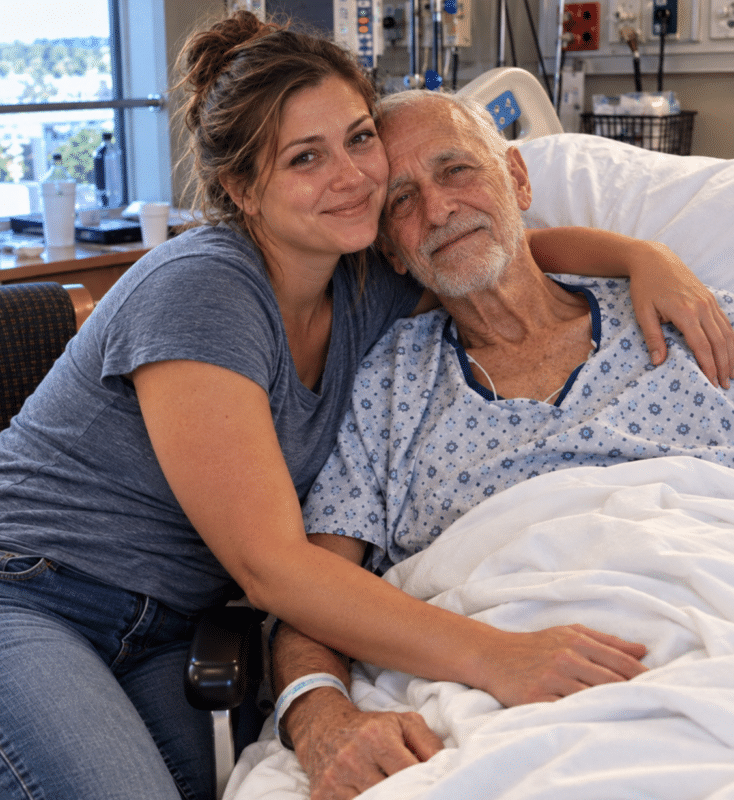
A Terminally Ill Stranger Across the Hall Begged Me to Pretend to Be His Daughter So He Wouldn’t Die Alone—The Morning He Passed, His Nurse Handed Me an Envelope and Asked, “You Really Don’t Know Why He Chose You?”
I thought I was just keeping a lonely man company while my mother healed across the hall. I thought the strangest thing he’d ever ask of me was to sit in his daughter’s empty chair. I was wrong. Thomas had chosen me for a reason – and the job he left behind was far bigger than a few afternoons of pineapple and bad television.
Part One: The Stranger Man with Nothing on His Walls
The day Thomas died, his bed was stripped before lunch.
That’s the image I still can’t shake. Not his face. Not his voice. Just a bare blue mattress in a room that had held him for weeks, the television dark, the curtains pulled open to a gray sky – as if the hospital wanted to erase him as quickly and politely as possible.
But I’m getting ahead of myself.
My mother went into the hospital for a surgery everyone kept calling “routine.” Routine turned into complications. Complications turned into almost six weeks of beeping monitors, lukewarm coffee, and me sleeping in a vinyl chair that folded out into something only a liar would call a bed.
That was how I met Thomas.
His room was directly across the hall from hers. I noticed him during my first week, and not because of anything he did. I noticed him because of what he didn’t have.
Every other room on that floor carried some proof of a life beyond those walls. Flowers wilting slowly in plastic vases. Mylar balloons sagging near the ceiling. Crayon drawings taped beside the bed. Family photos. Half-finished crossword puzzles left by grandkids who’d promised to come back tomorrow and finish them.
Thomas had none of that.
He had a television bolted to the wall, usually playing old black-and-white movies with the volume turned almost all the way down. He had a paperback novel that never seemed to get past the same twenty pages. And he had a chair beside his bed that nobody ever sat in.
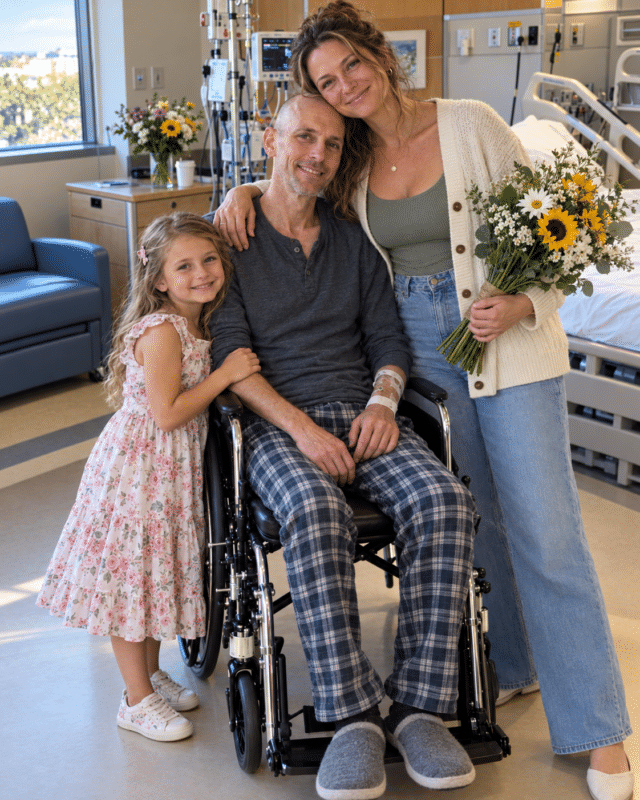
He looked around sixty. Maybe a little older. Thin in the way that isn’t natural, with sharp cheekbones and a stubborn jaw and eyes that watched the hallway more than the television.
I didn’t know what was wrong with him. I didn’t ask. In a hospital, you learn not to.
Then one afternoon, as I was stepping out of my mother’s room, I heard something clatter to the floor across the hall.
Thomas had dropped a plastic cup. He was leaning so far over the side of his bed, straining toward it, that his whole body looked like it might follow.
“You’re going to fall,” I said from the doorway.
He glanced up, completely unbothered. “So I’ve been told.”
I walked in, picked up the cup, and set it on his tray. “You could’ve pressed the call button.”
“I could’ve,” he agreed. “But then somebody would’ve marched in here and given me another lecture about reaching for things.”
“Probably because you shouldn’t be reaching for things.”
His mouth twitched at the corner. “You’re awfully judgmental for someone I met eleven seconds ago.”
“I’m not judgmental. I just tell it like it is.”
“Hmm.” He looked me up and down, slowly, the way a man studies a painting he isn’t sure he likes yet. Something flickered across his face – something I couldn’t read at the time. “I’m Thomas. And you are?”
“Sarah.”
“Well, Sarah,” he said, settling back against his pillows, “thank you for rescuing my cup.”
I didn’t know it then, but that was the first line of a story that would end with me holding a dead man’s secret in my hands.
Part Two: Pineapple, Bad Coffee, and a Man Who Snapped at Nurses
After that, Thomas waved whenever I walked past his room.
At first, I just waved back. Then, somewhere along the way, I started stopping.
It was never anything big. Five minutes here. Ten minutes there. My mother slept a lot, especially after physical therapy wore her out, and the hallway silence got heavy after a while. Thomas, it turned out, was very happy to have someone to complain to.
And oh, did he complain.
He hated the hospital coffee. He hated game shows. He hated the way the night nurse’s shoes squeaked. He had strong, passionate, borderline unhinged opinions about pineapple on pizza.
“Fruit does not belong on pizza,” he informed me one afternoon, like he was delivering a verdict.
“Tomatoes are fruit.”
He stared at me. “No.”
“They literally are, Thomas.”
“Not emotionally.”
I laughed so hard my mother’s nurse poked her head out to see what was going on.
A few days later, I walked into his room with a little plastic container of fresh pineapple chunks and set it on his tray with great ceremony. He looked at it the way someone might look at a spider.
“You’ve been lying awake plotting ways to annoy me.”
“Absolutely.”
“You’re a menace, Sarah.”
He ate every single piece.
That was how it went between us. Sometimes I brought fruit. Sometimes chocolate or a bag of those sour candies he pretended not to like. Once, I brought him real tea from the café downstairs after he declared that the hospital tea tasted like “hot rainwater filtered through a sock.”
We talked about everything. Movies we loved and movies we’d walked out of. Places we’d traveled. Terrible bosses. Whether breakfast food was acceptable for dinner. (He said yes. Emphatically.)
We almost never talked about why he was there.
I found out by accident. A doctor came in one afternoon while I was visiting, and I heard enough before I slipped out to understand. Stage four. Cancer. The kind of words that make the air in a room go thin.
When the doctor left, Thomas caught my face before I could fix it.
“Don’t start,” he said.
“Start what?”
“Looking at me like I’m already dead.”
“I wasn’t.”
“You were.”
“I was just thinking, Thomas.”
“That’s a dangerous habit. I’d drop it if I were you.”
I hesitated. I knew the smart thing was to change the subject. But I’ve never been very good at doing the smart thing.
“You know,” I said, “you could probably be nicer to the nurses.”
His eyebrows shot up. “Excuse me?”
“Especially Megan. She’s doing her job, and yesterday you snapped at her because your soup was cold.”
“My soup was cold.”
“She didn’t cook it.”
Thomas stared at me for a long second. And then he laughed – a real laugh, big and startled – that quickly collapsed into a coughing fit so violent it lasted almost a full minute. I stood up, half ready to hit the call button myself, but he waved me back down. When he finally caught his breath, he wiped his watering eyes with the back of his hand.
“You know something, Sarah?”
“What?”
“You’re not very good at telling people what they want to hear.”
“I warned you from the beginning. I tell it like it is. It’s probably a bad habit.” I reached for my bag. “I can leave if you’d rather.”
“No.” His voice changed. The joking fell away all at once. “No. Don’t do that.”
He said it like it mattered. Like I was the one thing in that room he couldn’t afford to lose.
The next morning, I passed Megan at the nurses’ station. She looked at me with a strange little smile.
“Whatever you said to him,” she murmured, “he said thank you this morning. First time in a month.”
Part Three: The Wedding He Never Saw
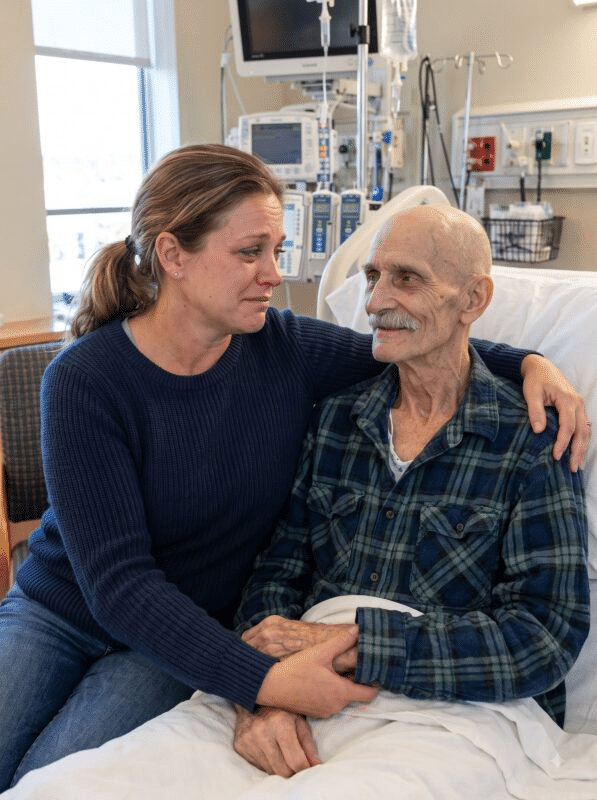
A week later, I caught my first real glimpse of the man Thomas had been before that hospital bed.
We were watching some ridiculous wedding show because he’d lost the remote somewhere in the tangle of his blanket and refused to let me dig for it. Normally, that kind of show would’ve been a gift to him. He would’ve spent the whole hour mocking the flower arrangements, guessing how much the reception cost, and predicting which couples would be divorced by Christmas.
But that day, he barely said a word.
On screen, a bride in a flowing white dress was walking barefoot down a beach toward the man waiting for her. The waves were soft. The music swelled. Her father was holding her arm, crying openly.
Thomas’s eyes didn’t leave the television.
“Do you think people remember who wasn’t there?” he asked quietly.
I glanced over at him. “At their wedding?”
“Years later.”
I thought about it. “Depends who was missing, I guess. And why.”
He didn’t answer right away. His hands were folded on his blanket, the knuckles pale. The bride reached her groom. Her father let go of her arm.
“There’s one wedding,” Thomas said, almost to himself, “I would’ve given anything to see.”
The words hung in the air between us.
“Whose?” I asked gently.
For one long second, I really thought he might tell me. His lips parted. His eyes shimmered.
Then the crooked smile came back, snapping into place like a shield.
“You ask too many questions.”
It was meant to be a joke. It didn’t land like one. Whatever wedding he’d been thinking of, he had missed it – and the regret in his voice was so raw, so old, that it followed me all the way home that night.
I lay awake wondering who in the world a man like Thomas would’ve given anything to see walk down an aisle.
I didn’t have to wonder for long.
Part Four: “Would You Pretend to Be My Daughter?”
A few days later, he asked me the question that changed everything.
He was having a bad day. I knew it the second I walked in. His skin had gone the color of old paper. Dark hollows sat under his eyes. The television was off, and the room was so quiet I could hear the IV pump clicking.
I sat down beside him and tried to keep my voice light.
“Want me to smuggle you some pineapple?”
“No.”
“Wow.” I shook my head. “We really are near the end.”
He smiled at that. But his eyes filled with tears, and that smile trembled in a way I’d never seen before.
Then he reached out and took my hand.
“Sarah,” he said, “can I ask you something strange?”
“You once spent twenty minutes explaining that pigeons are government incompetence in bird form. The bar for strange is pretty high, Thomas.”
He didn’t laugh.
That scared me more than anything the doctor had said.
“Your mother is going to go home one of these days,” he said slowly, staring down at the blanket. “And I… I’m going to be…” He stopped. Swallowed. Tried again. “Would you pretend to be my daughter?”
I was sure I’d misheard him. “What?”
“My real daughter hasn’t spoken to me in almost ten years.” His voice cracked on the number. “I miss her. God, I miss her.”
I didn’t know what to say. I just sat there, his cold fingers wrapped around mine, while he stared at our hands like they held an answer.
“You look a little like her,” he said. “Around the eyes, mostly.”
“Thomas…”
“I’m not asking you to call me Dad,” he said quickly. “I’m not asking you to lie to the doctors. Nothing like that. Nothing weird.” He drew in a shaky breath. “It’s just… when you’re sitting there, sometimes I can almost imagine things went differently.”
My chest tightened until it hurt.
He turned his head toward the empty chair beside his bed – the one no one had ever sat in but me.
“I don’t want to spend whatever time I have left staring at an empty chair.”
There were a dozen reasons to say no, and I knew every one of them. It was strange. It blurred lines I didn’t fully understand. And somewhere out there was a real daughter who had her own reasons – maybe very good ones – for staying away. Who was I to step into her place?
But as I looked at him, I realized Thomas wasn’t really asking me to replace her.
He was asking me not to leave him alone.
“Okay,” I said.
His fingers tightened. “Okay?”
“I’ll sit with you. Even after Mom goes home. I’ll keep coming.”
He nodded once, like he didn’t trust himself to do more. “Thank you.”
Then, so softly I almost missed it, he added, “You’re a good person, Sarah.”
I let out a shaky laugh. “You barely know me.”
Thomas held my gaze for a long moment. There was that look again – the one from the day of the dropped cup. The one I couldn’t read.
“I know,” he said. “But I know enough.”
At the time, I thought he meant I was kind enough to sit with a lonely old man.
Later, I would understand he meant something else entirely.
Part Five: The Envelope in the Bedside Drawer
My mother went home. I kept my promise.
Three, sometimes four afternoons a week, I drove back to that hospital, walked past the room that used to be my mother’s, and sat in the chair beside Thomas’s bed. Some days we talked for hours. Some days he slept, and I read his paperback out loud from the same twenty pages he never finished. Some days he just held my hand and watched the door.
I never once called him Dad. He never once asked me to.
But sometimes, when he was drifting off, he’d murmur, “You came,” in a voice so soft and so grateful that I understood exactly who he was talking to. And I let him.
Thomas died three weeks later.
I was actually at home when my phone rang, and I knew before I answered. Megan’s voice was gentle.
“Sarah, I’m so sorry. It was early this morning. It was peaceful.”
I drove to the hospital anyway. I don’t know why. There was nothing to do. But I couldn’t sit still.
When I stepped off the elevator and looked down the hall, his door was already open. His bed had already been stripped. The television was dark. The paperback he’d carried around for weeks, stuck on the same twenty pages, was gone.
The chair was still there. Empty.
I made it to the bathroom before I broke down. I cried harder than I expected to – harder than I thought I had any right to, for a man I’d known less than two months. But for weeks, I’d gotten used to walking down that hall and finding him there. Complaining about the coffee. Arguing about pizza. Pretending with every ounce of his stubborn strength that he wasn’t frightened or lonely.
Now there was only a bare mattress and a stranger’s room.
I was pulling myself together near the elevators when I heard quick footsteps behind me.
“Sarah! Wait.”
It was Megan. She was holding an envelope.
“Thomas left this for you,” she said, a little out of breath. “We found it in his bedside table this morning. He’d written instructions to give it to you directly.”
I stared at it. My name was written across the front in shaky block letters.
“Are you sure it’s for me?”
“Yes.”
“This doesn’t make any sense,” I said. “Why would he leave me anything?”
Megan tilted her head and gave me the strangest look – like she was trying to decide whether I was joking.
“Doesn’t make sense?” she repeated slowly. “Sarah… do you really not know why he chose you?”
A chill ran down my back.
“Chose me,” I said. “For what?”
She nodded at the envelope in my hands. “Open it.”
Part Six: A Wedding Ring and a Warning
My hands weren’t steady when I tore it open.
Inside was a handwritten letter, several folded pages sealed in a second, smaller envelope, and a set of papers on letterhead from an attorney’s office.
I read the legal paperwork first because it was on top, and because some part of me was hoping it would be something boring. It wasn’t.
Thomas had left me exactly one thing in his will.
His late wife’s wedding ring.
I read the sentence twice. Then a third time. The words refused to rearrange themselves into something that made sense.
For weeks, I had believed the strangest thing Thomas would ever ask of me was to pretend to be his daughter. This was stranger. Much stranger. Why would a man who had a daughter – a daughter he missed so badly it made him cry – leave his dead wife’s wedding ring to a woman he’d only known for a couple of months?
I sank into one of the plastic chairs by the elevator and unfolded his letter.
It answered that question just enough to open a bigger one.
Sarah,
By now you’re probably angry with me. Fair enough. But I have my reasons for what I’ve done.
The ring belonged to my wife, Margaret. My daughter will come looking for it – I’d bet my life on that, if I had much of one left to bet. When she does, don’t simply hand it to her. Before you give it over, tell her this:
“Your mother wanted you to have it.”
Then give her the enclosed letter.
I stared at those words until they blurred.
Until that moment, I’d assumed the ring itself was the mystery. Now it sounded like evidence. Like proof of something Thomas had done – something he’d never been able to say out loud.
The sealed pages were addressed to Rebecca. I didn’t open them. They weren’t mine to read.
But there was one more paragraph for me, at the very bottom of the page.
You looked like Rebecca. That’s why I first noticed you, the day you picked up my cup. But that’s not why I chose you for this.
I chose you because you told a dying man he was being a jerk to his nurse. Nobody else would have. You don’t tell people what they want to hear just because the truth is uncomfortable. You really do tell it like it is.
I need you to do that for me one last time.
– Thomas
I read it again. And again.
I know enough, he’d said.
He hadn’t been talking about kindness. He’d been testing me. From the very first day, Thomas had been watching to see whether I was the kind of person who would soften a hard truth to make someone feel better – or the kind who would say it straight, even when it hurt.
He needed someone who wouldn’t change the message.
I was still sitting there, the letter trembling in my lap, when footsteps came around the corner and stopped dead.
I looked up.
A woman stood in the hallway, staring at me. She was about my age. Same dark hair. Same shape to the face. And the eyes – God, the eyes. It was like looking into a mirror that had been left out in the rain for ten years.
I knew immediately.
“You must be Sarah,” she said.
I rose slowly to my feet. “Rebecca?”
She didn’t bother with hello. Her voice was cold and sharp and shaking underneath.
“Why did my father leave you my mother’s wedding ring?”
Part Seven: The Lie That Cost Ten Years
A couple walking past slowed down, openly staring. A nurse at the station looked up from her computer.
“I…” I glanced down at the letter in my hand, then back at her. “Because I tell it like it is.”
Rebecca’s face twisted. “What is that supposed to mean?”
“I should explain.” I took a breath. “Honestly, I barely knew Thomas. My mother was in the room across the hall from his. We started talking. He was alone all the time. And eventually… he asked me to pretend I was his daughter.”
Rebecca went rigid. “He did what?”
I watched it land on her. Watched her eyes move over my face – my hair, my jaw, my eyes.
“Oh,” she breathed, and there was something awful in the way she said it. “Because you look like me.”
“That’s why he noticed me,” I said quietly. “It’s not why he chose me.”
“Then why?”
I lifted the letter and read his words out loud, exactly as he’d written them. I didn’t soften anything. That was the whole point.
“He asked me to tell you that your mother wanted you to have the ring.”
Everything drained out of her face.
“No,” she whispered. Then louder: “No. That’s not true. Dad told me Mom wanted him to keep it. He told me she changed her mind before she died.”
I held out the sealed pages. “Then read this.”
She snatched them from me. Tore the envelope open right there in the hallway. I watched her read the first page, her jaw clenched tight, her eyes flying across the lines.
By the second page, her hands were shaking.
“He lied to me,” she said. Her voice broke apart. “He lied. Mom promised me that ring. She promised me I’d wear it on my wedding day. I was twelve years old when she first told me. And after she died, he looked me in the eye and said she’d changed her mind – that she wanted him to have it. We fought so badly over it that I told him…”
She stopped. Pressed a hand to her mouth.
“I told him not to come to my wedding.”
Thomas’s voice rose in my memory like a ghost. There’s one wedding I would’ve given anything to see.
“I thought he’d apologize,” Rebecca went on, faster now, the words spilling out of ten years of silence. “I thought he’d come to his senses and call me. He thought I’d back down. Neither of us did. I got married without my mother’s ring and without my father, because he lied. And then he waited ten years – ten years – only to have my lookalike read me a script in a hospital hallway?”
Her voice echoed off the walls.
“Ma’am.” A nurse had stepped out from behind the station, her tone firm but kind. “I’m sorry, but you can’t do this here. Please take it outside.”
Rebecca was already walking.
I followed her down the elevator, through the lobby, and out under the hospital’s concrete awning, where a thin drizzle was coming down. She stood near a pillar and finished reading the rest of her father’s letter while I stood a few feet away and said nothing.
When she was done, she told me what it said – not all of it, just enough.
Thomas had kept the ring because he couldn’t bear to part with it. Margaret had worn it every single day for thirty-one years. It was the last piece of her he could hold in his hand. When Rebecca asked for it, grief made him panic, and panic made him lie. And once the lie was spoken, shame took over. Every day he didn’t take it back made it harder to take back the next. One lie turned into ten years of silence.
Rebecca lowered the pages and stared out at the wet parking lot.
“He had ten years,” she said. “Ten years to pick up the phone.”
I didn’t defend him. I couldn’t. He’d made his choices, and she was right about every one of them.
She turned to look at me, her eyes red. “Why you? Really?”
I handed her Thomas’s letter to me and let her read the last lines for herself.
She was quiet for a long moment. Then she let out a bitter little breath that was almost a laugh.
“So he needed a messenger.”
“Someone who wouldn’t change the message,” I said.
“He still should have told me himself.”
“Yes,” I said. “He should have.”
She looked surprised – like she’d expected me to argue, or make excuses for him, or tell her he’d been a good man underneath it all.
But I don’t tell people what they want to hear. That was exactly why I was standing there.
Part Eight: The Ring Comes Home
It took several weeks for the estate to formally release the ring to me.
When the small velvet box finally arrived, I didn’t open it. It wasn’t mine to open. I set it on my kitchen counter, stared at it for a long time, and then picked up my phone and called Rebecca.
We met outside the hospital. It felt like the only right place.
The weather had turned since that day under the awning. The sky was a clean, cold blue. Rebecca was waiting on a bench near the entrance, her coat pulled tight around her, looking less angry and more tired – the kind of tired that comes after you finally set down something heavy you’ve been carrying for years.
This time, I didn’t make her ask.
I walked up and held out the box.
She took it with both hands. For a moment, she just held it, like she wasn’t sure she was allowed. Then she opened the lid.
The ring was simple. A thin gold band, worn smooth, with a small diamond set low so it wouldn’t catch on anything. The kind of ring made to be lived in, not looked at.
Rebecca stared at it for a very long time. Then she slipped it onto her finger.
It fit.
Her thumb moved slowly over the worn gold, turning it around and around.
“My mom used to do this,” she said softly, her voice barely there. “Whenever she was thinking about something. At the dinner table. In the car. On the phone. She’d just turn it around and around without even noticing.”
She did it again, without seeming to realize.
And standing there, watching her, I finally understood why they had both wanted that ring so badly.
Thomas had clung to it because it was the last thing Margaret had worn every day of their life together. Rebecca had wanted it because she needed a piece of her mother beside her on the most important day of her life. The same small circle of gold had meant comfort to both of them.
And Thomas’s lie had turned it into the wall that kept them apart.
Rebecca looked down at her hand. Her eyes filled. “I wish he’d just told me.”
I thought of Thomas in that hospital bed, staring at a stranger’s wedding on a television screen, his knuckles white against the blanket.
“So did he,” I said. “Rebecca, he told me once that there was a wedding he would’ve given anything to see. Anything. He couldn’t even say whose it was. But I knew. I think I knew the moment I saw you.”
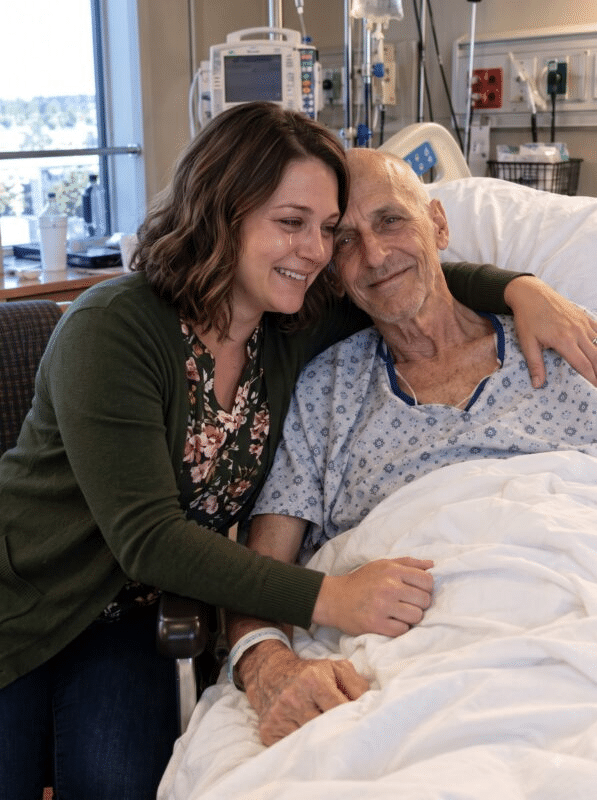
She pressed her lips together hard. A tear slipped down her cheek, and she didn’t wipe it away.
“He sat in that room alone,” she whispered. “For weeks.”
“Not the whole time,” I said. “Not at the end.”
She looked at me then – really looked, the way her father had that first day. Something in her face shifted. The anger didn’t disappear. I don’t think it ever fully will. But something underneath it loosened, just a little.
“You sat with him,” she said.
“Every week.”
“In my chair.”
“In your chair,” I said. “But he never once forgot it was yours.”
She closed her fingers around the ring and held her hand against her chest, right over her heart.
“Thank you,” she said, “for telling me the truth. Even the parts that hurt.”
“Especially those,” I said. “That’s what he wanted.”
She stood, gave me a small, unsteady nod, and walked toward the parking lot. I watched her go, the winter sun catching on the gold at her finger as she turned the ring around and around, exactly the way her mother used to.
I stayed on that bench for a long time after she’d gone.
I thought about the dropped plastic cup. The pineapple. The cold soup. The empty chair. A lonely man who couldn’t find the courage to tell his own daughter the truth – so he spent his last weeks searching for someone who could.
Thomas didn’t choose me because I looked like Rebecca.
He chose me because he knew I wouldn’t lie to her.
And in the end, that was the only thing he had left to give her: not an apology he was too proud to say, not a phone call he was too ashamed to make, but the truth – delivered by a stranger, the way he never could.
It wasn’t enough. It could never be enough to make up for ten lost years.
But it was honest.
And sometimes, honest is the only kind of goodbye we get.
Note: This story is a work of fiction inspired by real events. Names, characters, and details have been altered. Any resemblance is coincidental. The author and publisher disclaim accuracy, liability, and responsibility for interpretations or reliance. All images are for illustration purposes only.