
After Four Daughters, My Husband Begged for a Son—
I thought losing our baby boy was the worst thing that could happen to me. Then my husband walked up to our front door with a stranger’s son wrapped in the blanket I’d sewn for ours – and the secret behind that baby went back further than I ever imagined.
Part One: The Son He Always Wanted After 4 Daughters
In ten years of marriage, Tom and I had raised four wonderful girls.
Sophie was nine, serious and watchful, the kind of child who noticed everything and said half of it. Ava was seven and never stopped talking. Lucy was five and thought every room was a stage. And our baby, Rosie, had just turned three and believed with her whole heart that she was in charge of all of us.
Our house was loud. It smelled like crayons and burnt toast and strawberry shampoo. There were hair ties on every surface and glitter in places glitter should never be. I loved it exactly the way it was.
But Tom had always dreamed of a son.
He never said it in a way that made the girls feel small. He adored them. He braided hair badly, sat through dance recitals with tears in his eyes, and let Rosie paint his toenails purple. But every so often, when he watched a father and son tossing a ball in the park, I’d see something flicker across his face. A wish he didn’t quite know what to do with.
“One more,” he said one night, after the girls were asleep. “Just one more try. If it’s another girl, I’ll be the happiest man alive. I just want to know we tried.”
So we tried.
For nearly two years after Rosie was born, we tried. There were negative tests and quiet disappointments, and then, finally, two pink lines. Then came the long wait for the 19-week scan.
I’ll never forget the way the room went still when the technician smiled and said, “Looks like you’re having a boy.”
Tom made a sound I had never heard from him before – half laugh, half sob. He kissed my forehead, then my hand, then my forehead again. In the parking lot, he called his mother, Diane, and could barely get the words out.
That night, I pulled out my sewing box and started on a baby blanket. Soft blue cotton, hand-stitched along the edges, with a tiny embroidered star in one corner. I worked on it every evening for two weeks, the girls crowded around me arguing over what to name their brother.
Three weeks after that scan, I lost him.
I don’t remember much about the first night in the hospital. I remember the lights. I remember a nurse holding my hand. And I remember Tom standing beside my bed, staring at the wall instead of at me.
“You know how much I wanted a son,” he said quietly. “I really thought this was our chance.”
I knew he was grieving. I knew he didn’t mean it the way it sounded.
But I heard those words every time I closed my eyes.
Part Two: The Baby on the Porch
There were complications. One week in the hospital became two, and two became nearly four. Tom visited, but he was distant – checking his phone, stepping into the hallway to take calls, leaving earlier than he needed to. I told myself it was grief. Everyone grieves differently. I of all people should have known that.
When my sister Megan finally drove me home, I was desperate to see my family. I’d been imagining it for days: the girls running down the hallway, Rosie throwing herself at my knees, Tom wrapping his arms around all of us.
Instead, when I walked into the kitchen, all four of my daughters were sitting silently at the table.
Nobody ran to hug me.
Sophie kept glancing down the hall, then back at me, then down the hall again.
“Hi, my loves,” I said softly. “Where’s Dad?”
“He went out,” Sophie said.
“Did he know I was coming home today?”
She nodded without looking at me.
I called Tom. Voicemail. I called again. Voicemail.
Megan squeezed my shoulder. “Sit down. I’ll make you tea.”
But I couldn’t sit. Something felt wrong in the house, like a picture hanging slightly crooked. I started down the hall toward the nursery – the room we’d begun painting a soft sage green just weeks before.
Sophie slid off her chair and stepped in front of me.
“Dad said to wait for him.”
“Wait for him for what, sweetheart?”
She bit her lip. “He just said to wait.”
Before I could ask anything else, the doorbell rang.
Lucy reached the door first, the way she always did. She pulled it open, looked outside, and then backed away slowly, one hand pressed over her mouth.
“Mom?” she cried.
I ran to her.
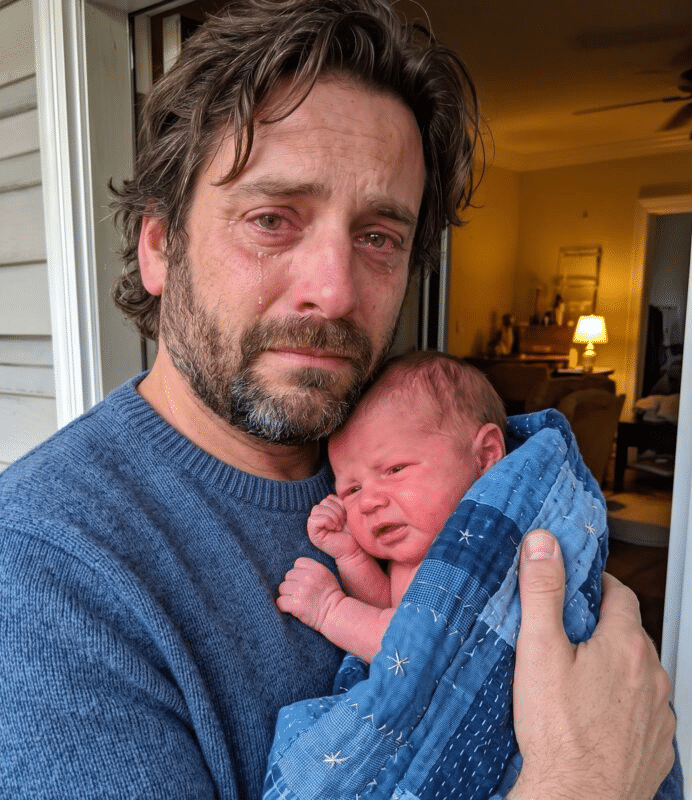
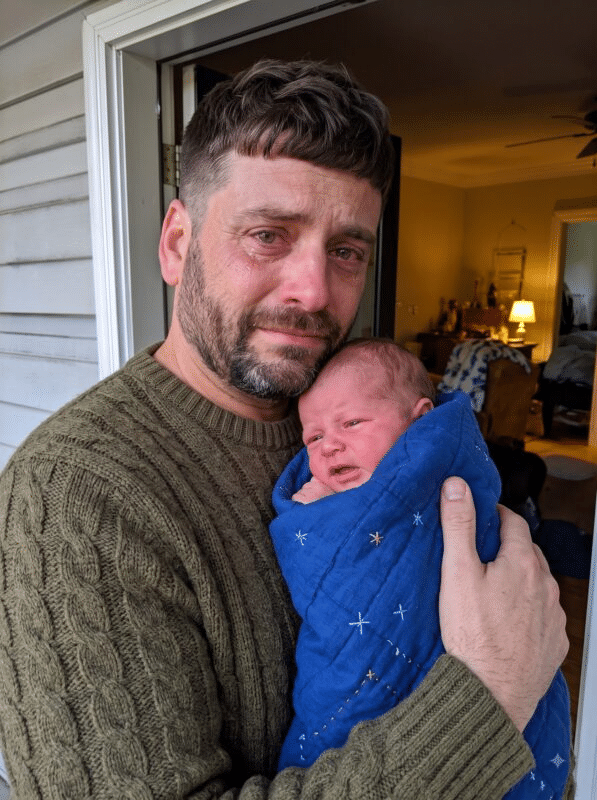
Tom was standing on the porch. His eyes were red and his face was wet with tears. And in his arms was a newborn baby – tiny, red-faced, squirming against his chest.
Then the baby started to cry.
My body reacted before my mind did. Weeks of aching, of empty arms, of milk that had come in for a child who wasn’t there – I took half a step toward that crying baby without even thinking.
Then I saw the blanket.
Blue. Hand-stitched. A tiny embroidered star in the corner.
The blanket I had made for the son I came home without.
“Tom,” I whispered. “Whose baby is that?”
He looked at me for a long moment. Then he gently turned the baby so I could see his face.
“You’d better sit down,” he said. “I’ll understand if you hate me after this.”
I didn’t sit.
Part Three: The Man He Swore He’d Never Become
To understand what happened next, you need to understand something about Tom.
I’m a psychologist. But I didn’t need a degree to figure out what could shut my husband down faster than anything in the world: any comparison to his father, Richard.
When we first started getting serious, I made the mistake of joking about it. We were lying on a blanket in the park, and I nudged him and said, “Just don’t wake up at fifty and turn into your father.”
He went completely still.
“My father spent his whole marriage putting himself first,” he said.
“And your mom stayed?”
“For years. I watched her forgive things she never should have had to forgive. The women. The lies. The nights he didn’t come home.” He stared up at the sky. “I used to lie awake listening to her cry through the wall.”
“And you were terrified you’d end up like him,” I said gently.
He turned and looked at me.
“I’d rather die than do that to my wife.”
I believed him. I still believe he meant it.
Over the years, Tom walked away from Richard completely. He built his own company from nothing. He refused every cent of his father’s money. And after one final, ugly fight a few years into our marriage, he stopped speaking to him altogether. Diane had finally divorced Richard by then, and Tom stayed close to her. His father simply became a name nobody said at the dinner table.
For years, I thought that meant Richard was out of our marriage for good.
Then, sometime during my pregnancy, things began to change.
Tom’s phone started ringing during dinner. He’d glance at the screen and step outside.
“Who was that?” I asked one night.
“Work.”
“At nine thirty?”
“Different time zone.”
A week later, I noticed he was taking his phone into the bathroom with him. Every time.
“Why are you bringing your phone into the shower?”
Tom stopped in the doorway. “I always do.”
“No,” I said. “You don’t.”
He laughed it off and closed the door.
Another afternoon, I walked into his home office and found him whispering with his mother. Diane stopped mid-sentence the second she saw me.
“What?” I asked.
“Nothing,” Tom said, too quickly.
I looked at Diane. She had always been warm with me – the kind of mother-in-law who remembered every birthday and showed up with soup whenever one of the girls was sick. “What were you two talking about?”
She glanced at Tom. “Family stuff.”
“I’m family.”
“I know, sweetheart.”
“Then tell me.”
Tom stepped between us. “Leave Mom out of this.”
“Out of what?”
Neither of them answered. That bothered me more than if they’d simply lied to my face.
Then came the night he came home after midnight. I was sitting up in bed, one hand on my belly, when I heard his keys in the door.
“Where were you?”
“Helping someone.”
“At midnight?”
“She needed me.”
Something about the way he said she made me sit up straighter.
“Who?”
Tom set his keys down, picked them back up, and turned them over in his hand. “It’s complicated.”
That was the first time I wondered whether Tom’s greatest fear wasn’t becoming his father.
Maybe it was admitting that he already had.
I should have pushed harder. Instead, I did what I’d always been very good at doing with Tom. I found an explanation that let me stop asking questions. He was stressed about the business. He was nervous about the baby. He was helping a coworker through a crisis.
Now, standing in our doorway, staring at that baby in my son’s blanket, every one of those strange moments rearranged itself into one terrifying picture.
Part Four: “It’s Not Only My Secret”
“Who is he?” I asked again.
Tom swallowed. “His name is Noah.”
“I didn’t ask his name.”
The baby’s cries grew louder. Tom tucked him closer and began rocking him, slow and automatic, the way he’d rocked each of our girls.
I had imagined him doing exactly that with our son so many times that, for one horrible second, I couldn’t breathe.
“His mother’s name is Vanessa,” Tom said. “She can’t take care of him right now. I promised her he wouldn’t be alone.”
“Vanessa who?”
His eyes flicked toward the girls, who were huddled in the hallway behind me. “Please. Not in front of the kids.”
“Vanessa who, Tom?”
“I’ve known her for a few months.”
My knees nearly gave out. Megan appeared at my elbow and caught my arm.
“A few months,” I repeated.
“Sophie,” Tom said, “take your sisters upstairs.”
“Dad—”
“Please, sweetheart.”
Sophie took Rosie’s hand and herded the others up the stairs. Megan hesitated, then followed them, throwing me one last look over her shoulder.
When they were gone, I pointed at the blanket.
“That’s our son’s blanket.”
“I know.”
“You knew I was coming home today.”
“Yes.”
“And you thought this was how I should find out?”
“No.” His voice cracked. “I was going to tell you first. I swear I was.”
“Then why is there a newborn standing on my porch?”
Tom looked down at the baby, who had quieted to small hiccupping whimpers.
“Because I thought I had more time. This morning, I found out I didn’t.”
“More time for what?”
His jaw tightened. “I can’t explain that without telling you something that isn’t mine to tell.”
I made myself ask it. “Did you sleep with her?”
“No.” He said it instantly, firmly, looking me straight in the eye. “I have never cheated on you. Never.”
“Then whose baby is in your arms?”
He closed his eyes. “I can’t tell you that yet.”
“You can’t tell me?”
“It’s not only my secret.”
I laughed – a sharp, ugly sound I didn’t recognize. “You’ve been hiding phone calls. You’ve been coming home after midnight. And now I find out there’s a woman you’ve known for months, and you’re standing on our porch holding her baby in our dead son’s blanket.”
“I was trying to help.”
“Then tell me the truth.”
“I promised someone.”
“Well,” I said, “apparently that promise matters more than your marriage.”
He flinched as if I’d slapped him.
But he still didn’t answer.
The worst part wasn’t believing that Tom might have cheated. It was realizing that he expected me to live with the evidence – to walk past it in my own hallway – while he protected somebody else’s secret.
I went upstairs, kissed each of my daughters, packed a bag, and spent the night at Megan’s.
Part Five: The Coffee Shop
I didn’t sleep.
By morning, I’d done something I’m not proud of as a professional, but that I completely understand as a human being.
I went looking.
It didn’t take long. Months earlier, an old shared bank account had sent me a notification about a payment I hadn’t thought twice about. I dug it up. There was a last name attached. From there, it took fifteen minutes to find her online.
Vanessa. Twenty years old. A college student with a handful of photos and a profile picture of a sunset.
Twenty.
I typed the message three times before I sent it.
Me: I’m Tom’s wife. I need ten minutes.
She replied almost immediately.
Vanessa: Did he finally tell you?
We met at a coffee shop across town that afternoon. I arrived early and chose a table in the corner. I’d expected to walk in and see a glamorous young woman – someone who’d make me feel old and tired and replaceable.
Instead, the girl who walked through the door looked exhausted. Pale, hollow-eyed, wearing a hoodie two sizes too big. She sat down carefully, the way you sit when your body is still recovering.
Her first words were, “Where’s Noah?”
“With Tom.”
She let out a long breath, and her shoulders dropped.
I didn’t waste time. “Tom made me think the two of you were sleeping together.”
Her face went completely blank. “Tom? God, no.”
“Then why has my husband been secretly paying your expenses?”
Vanessa blinked twice. “You really don’t know.”
“Know what?”
She leaned forward and lowered her voice.
“Tom is Noah’s brother.”
For several seconds, I honestly thought grief had damaged my ability to understand English.
“Say that again.”
“Richard is Noah’s father.”
“Richard?”
“Tom’s dad.”
I stared at her. “No.”
“Yes.”
“They haven’t spoken in years.”
“I know.”
“Then how do you know Richard?”
Her eyes dropped to the table. “I was seeing him.”
“You’re twenty,” I said slowly. “He’s sixty-three.”
“I know.” Her voice was tiny. “He was charming at first. Generous. He took me to nice places. He made me feel like I mattered. And then I got pregnant.”
“And?”
“Everything changed overnight. He said he’d already raised his heir. He gave me an envelope of money and told me to handle it.”
“Handle it,” I repeated.
“I was going to end the pregnancy. My family has no money. They didn’t even know I was seeing anyone. I was terrified.”
“So how did Tom get involved?”
“I found Diane,” she said. “I wanted to know what kind of man Richard really was. I thought maybe she could tell me if I was crazy.” She twisted her napkin. “She listened to the whole thing. Then she called Tom.”
“And he came to see you.”
Vanessa nodded. “I thought he’d hate me. I thought he’d call me a gold digger or tell me to get lost.”
“What did he say?”
She looked up, and her eyes filled.
“He said, ‘Whatever my father did, that baby didn’t do it.‘”
I pressed my fingers against my temples. That sounded exactly like Tom. It was the reason I’d married him.
“Did he convince you to keep the pregnancy?”
“No. He was really careful about that. He said the decision was mine and he’d respect it either way. But when I told him I didn’t think I could go through with it because I’d be completely alone…” She wiped her eyes. “He said I wouldn’t be.”
Strangely, that made me angrier.
“So he supported you for months,” I said, “without telling me.”
“He kept saying he wanted to tell you. Every time I saw him.”
“But he didn’t.”
“Diane begged him not to.”
“Why?“
Vanessa hesitated. “She said Richard had already destroyed enough of her life. You were pregnant, you were happy, and she couldn’t stand the idea of his mess reaching your family too.”
“So she decided I was better off not knowing.”
“I think she really believed she was protecting you.”
I almost laughed. Apparently, everyone had been protecting me. Everyone except the person actually asking.
Part Six: “He Said He’d Handle It”
“You knew about me,” I said.
“I knew his wife was pregnant. I didn’t know much else. He didn’t talk about you much – I think because it hurt him to keep it from you.”
“And after I lost my son?”
Vanessa’s face crumpled. She was quiet for a long time.
“That’s when I told Tom I was choosing adoption.”
My stomach tightened. “What?”
“I can’t do this,” she whispered.
“Do what?”
“Be Noah’s mother.” Tears slid down her cheeks, and she didn’t bother wiping them away. “Please don’t think I’m a monster.”
I looked at this girl – barely older than a child herself, sitting in a coffee shop two weeks after giving birth, begging a stranger not to hate her – and the psychologist in me finally pushed past the wife.
“Why can’t you keep him?” I asked, more gently.
“I’m twenty. I haven’t finished college. I share a tiny room with two roommates.”
“And your family?”
“They still don’t know. I hid the whole pregnancy. I have no money, no apartment, no car. Nothing.”
“But you love him.”
“Of course I do.” Her voice broke completely. “I held him and I loved him so much it scared me. And I still knew I couldn’t give him a life when I don’t even have one myself.”
I handed her a napkin. She took it.
“So Tom brought him home,” I said.
“He picked Noah up from the hospital this morning.”
“Why him?”
“Because I called him at six a.m. and said I couldn’t take Noah home. I’d been sitting in that hospital bed all night, staring at him, and I just… couldn’t.”
“And that’s when Tom offered to adopt him?”
She shook her head. “He’d brought it up right after Noah was born. Said if I ever decided I couldn’t do it, Noah would have a home. I kept telling him I hadn’t decided.”
“Until this morning.”
She nodded. Then she looked up at me, and her expression turned careful.
“I asked him three times if you agreed. Three times.”
“And?”
“He said he’d handle it.”
I stood up so fast my chair screeched against the floor. A few people turned to look.
“Did he ever tell you why?” I asked. “Why he was so determined?”
Vanessa hesitated. “Not really. Every time I asked, he just said Noah wasn’t going to be abandoned because of something Richard did.”
That was enough.
Tom hadn’t cheated on me. I believed that now.
But somewhere along the way, he had made a decision about my marriage, my daughters, and a newborn baby – without me.
And I still didn’t fully understand why.
I left money on the table, told Vanessa to take care of herself, and drove home to find out.
Part Seven: Everyone Got a Vote Except Me
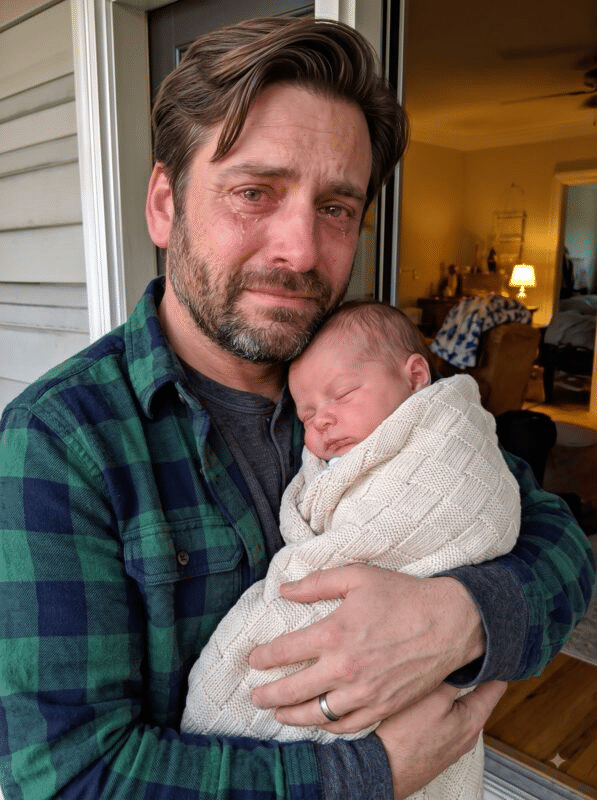
Tom was sitting on the living room couch with Noah asleep against his chest. Diane sat beside him, a bottle in her lap.
He looked up the moment I walked in.
“You met Vanessa.”
“Yes.”
Diane’s face fell. “Oh, honey. I’m so sorry.”
I turned to her. “You told him not to tell me.”
“I did.”
“Why?”
She set the bottle down slowly. “Because every single time Richard cheated, somebody told me I was better off not knowing. His friends. His brother. Even my own mother.” She shook her head. “I spent thirty years hating them for that. And somehow I convinced myself this was different.”
“That keeping me in the dark was protecting me.”
“Yes.”
“It wasn’t.”
“I know.” Her eyes were wet. “I know that now.”
“Do you? Because from where I’m standing, it looks like everybody got a vote in my family except me.”
Tom stood carefully, still holding Noah. “I can explain.”
“Good,” I said. “Then explain why you decided to become your own brother’s father without asking your wife.”
He flinched at the word brother, but he didn’t look away.
“I tried to make Richard take responsibility first.”
“You talked to him?”
“Three times.”
“So that’s where you were. The late nights.”
“Yes.”
“What happened?”
Tom’s voice went flat. “The first time, he laughed in my face. The second time, he offered Vanessa more money to disappear. The third time, he told me Noah wasn’t his problem.”
“That’s it?”
“He said he’d already raised the son he wanted.”
I understood. “You.”
“Yes.” Tom’s jaw clenched. “And then we lost our boy.”
The room went very quiet. Diane reached over and took the bottle from the table, just to have something to hold.
“I was standing in that hospital,” Tom said, “looking at you in that bed, and I felt like I’d failed you. Failed him. I couldn’t fix anything. I couldn’t do anything at all. And then my phone rang, and it was Vanessa, and she said she wasn’t sure she could keep Noah.”
“You couldn’t save our son,” I said slowly. “And then your father threw away another one.”
“I kept thinking that if I could just make one thing different from what Dad would have done…” He trailed off.
“This wasn’t only about Noah.”
“No,” he admitted. “It wasn’t.”
“You spent your whole life trying not to become Richard,” I said. “And you went so far in the other direction that you stopped asking what anyone else wanted.”
He was silent for a long moment.
“Yes.”
And the worst part was that I understood him. I could see every step of it – the grief, the guilt, the desperate need to be the opposite of his father. If one of my clients had described this situation to me, I’d have nodded and called it completely human.
A week earlier, that understanding might have been enough to excuse him.
Not anymore.
“You didn’t cheat on me,” I said.
“No.”
“But you lied to me for months.”
“I know.”
“You brought a newborn into our home weeks after we lost our son. And you wrapped him in his blanket.”
Tom looked away. “I didn’t even realize which one I’d grabbed until I saw your face on the porch.”
“That almost makes it worse.”
“I know.”
“Don’t you see? You were already turning Noah into a replacement. You didn’t even notice you were doing it.”
“I wasn’t trying to.”
“I know you weren’t,” I said. “That’s the problem.”
I took a breath.
“You promised another woman that we would raise her child before you ever asked me whether I could survive walking past that nursery.”
Tom covered his face with his free hand. “I know.”
“No. I need you to actually hear this. Your reasons explain what you did. They don’t erase it.”
“I hear you.”
“You took away my right to be part of a decision about our own family.”
“I did.”
“And if we’re going to stay married, you never, ever get to call secrecy protection again. Not once.”
He lowered his hand and looked at me, really looked at me, for the first time since I’d come home.
“I won’t,” he said. “I promise.”
Part Eight: Choosing Him Together
I didn’t forgive him that afternoon.
I didn’t forgive him that week, either.
We talked until two in the morning, night after night. We fought in whispers so the girls wouldn’t hear. We cried in the car in the grocery store parking lot. Tom started seeing a therapist of his own – something I’d suggested for years, and he’d always waved away.
And through all of it, Noah stayed with us while the grown-ups figured out what came next.
The girls adored him instantly. Ava narrated his every move. Lucy sang him songs she made up on the spot. Rosie appointed herself his official protector and announced to anyone who would listen that he was “her baby.”
One night, around three in the morning, Sophie padded into the kitchen and found me sitting in the dark with Noah in my arms, giving him a bottle.
She climbed into the chair beside me and watched for a while.
“Is he our brother?” she finally asked.
“I don’t know yet, sweetheart.”
She leaned over and sniffed the top of his head.
“He already smells like one.”
I laughed – really laughed – for the first time in weeks.
Vanessa kept visiting. At first, she’d sit stiffly on the edge of the couch, almost afraid to touch him. Over time, she relaxed. She’d hold Noah for an hour and talk to him softly, and the girls would bring her drawings.
One afternoon, she sat across from Tom and me at the kitchen table.
“I still want the adoption,” she said quietly. “I need to finish school. I need to figure out who I am. But I want him to have this.” She gestured toward the noise coming from the living room. “All of this.”
“You can still know him,” I told her. “If you want to.”
“Only if that’s good for him.”
“Then we’ll figure out what’s good for him together.”
She cried. So did I.
That night, after the girls were asleep and the house was finally quiet, Tom sat down next to me on the edge of our bed. He didn’t announce anything. He didn’t present me with a plan.
He just asked.
“Do you want to adopt him?”
It was the question he should have asked months ago. And hearing it, finally, mattered more than I can explain.
“I have one condition,” I said.
“Anything.”
“Noah is not our son’s replacement. Not ever. Our boy was real, and he was ours, and he gets to be missed.”
“I know,” Tom said, and his voice broke. “I know.”
“If I say yes, it’s because I want Noah. Not because you rescued him. Not because Richard rejected him. Not because it fills a hole. Because we choose him. Together.”
Tom looked at me. “Do you? Choose him?”
I looked toward the hallway, toward the soft glow of the nightlight, where an hour earlier our girls had been arguing at full volume over who got to hold him next.
“Yes,” I said. “But this time, we do it together.”
That night, before I went to bed, I took the blue blanket out of Noah’s bassinet.
I washed it by hand in the bathroom sink, the way I’d once imagined washing it after a spit-up or a long day at the park. Then I folded it carefully and laid it in a small wooden box, beside the ultrasound photo and the tiny hospital bracelet with no name on it.
“What are you doing?” Tom asked from the doorway.
“Giving it back to him,” I said. “It was always his.”
Tom didn’t argue. He knelt beside me, and for a long time, we just sat on the bathroom floor with that box between us and grieved our son. Together this time. Not in separate rooms, not with one of us hiding a phone.
The next weekend, the girls and I made Noah a blanket of his own. Yellow, because Rosie insisted that yellow was “a happy color.” Sophie cut the fabric. Ava picked the thread. Lucy sewed a crooked heart into one corner, and Rosie mostly just sat on it. It was lumpy and uneven and stitched by four pairs of small, clumsy hands and one pair of patient ones.
It was perfect.
Epilogue: What He Took Back
The adoption was finalized eleven months later, on a gray, drizzly Tuesday in March.
The girls insisted on dressing up. Diane came, clutching a tissue before we’d even found our seats. Vanessa sat beside her in the second row, holding Noah’s yellow blanket in her lap.
When the judge asked whether we both understood and agreed to everything we were signing, Tom didn’t answer first.
He turned and looked at me. And he waited.
It was such a small thing. Most people in that room wouldn’t have noticed. But I noticed. A year earlier, he’d have answered for both of us.
“We do,” I said.
“We do,” Tom repeated, and his voice cracked on the second word.
Outside the courthouse, Vanessa held Noah for a long time. Then she handed him back to me and hugged me hard.
“Thank you for choosing him,” she whispered. “Not just taking him. Choosing him.”
A week later, an envelope arrived in our mailbox. No return address, but I recognized the handwriting from old Christmas cards Diane had kept. Inside was a check from Richard, made out for an obscene amount of money, and a single line on a sticky note.
For the boy.
Once, Tom would have hidden that envelope. He’d have handled it alone, at midnight, and told me it was work.
Instead, he walked straight into the kitchen, set it on the table in front of me, and pulled out a chair.
“This came,” he said. “What do you want to do?”
We decided together. We tore the check in half and mailed it back. Tom wrote one sentence on the back of the sticky note, and he showed it to me before he sealed the envelope.
He already has a father.
We never heard from Richard again.
Noah turned one that summer. We threw him a party in the backyard with too many balloons and a cake that Lucy decorated so enthusiastically it was mostly sprinkles. Vanessa came straight from her summer classes. Diane brought enough food for fifty people. By the end of the afternoon, Tom was lying flat on his back in the grass with all five of our children piled on top of him, shrieking with laughter.
Later, when everyone had gone home and the girls were in the bath, I stood at the kitchen sink scrubbing frosting off plates. Tom came up beside me, took a towel, and started drying without saying anything.
Then he stopped.
“I need to take something back,” he said.
I turned off the water.
“That night in the hospital,” he said quietly. “What I said to you. About how much I wanted a son.”
My hands went still on the edge of the sink. I hadn’t known he remembered.
“I think about it every day,” he said. “You had just lost our baby, and the first thing I gave you was my disappointment. Like you’d failed me. Like our girls weren’t already everything.” His eyes were wet. “I had everything I ever wanted long before I said those words. Four daughters who would fight a dragon for each other. You. I was just too busy running from my father to see it.”
He set the towel down.
“I’m sorry. I should have said it a year ago. I’m saying it now.”
For months, those words in the hospital had played in my head every time I closed my eyes. I’d learned to live around them, the way you learn to walk around a broken step in your own house.
Standing there in the kitchen, with soapy water dripping off my wrists and the sound of four little girls singing in the bathtub upstairs, I felt that step finally mend.
I leaned my head against his shoulder.
“Thank you,” I said. “I needed to hear that.”
Upstairs, Noah started fussing. Before either of us could move, we heard Sophie’s voice drift down the stairs, bossy and tender at the same time.
“I’ve got him! Nobody panic!”
Tom laughed. So did I.
Vanessa finished college the following spring. She comes to every birthday, sits on the floor with the kids, and Noah calls her “Nessa” and runs straight into her arms the moment she walks through the door. One day, when he’s old enough, we’ll tell him the whole story – all of it, the hard parts too. There will be no more secrets in this house.
Tom and I rebuilt our marriage slowly, one honest conversation at a time.
I understood why he did what he did long before I forgave him.
I just stopped confusing understanding with permission.
And the night he finally asked me – really asked me – was the night I knew we were going to be okay.
Note: This story is a work of fiction inspired by real events. Names, characters, and details have been altered. Any resemblance is coincidental. The author and publisher disclaim accuracy, liability, and responsibility for interpretations or reliance. All images are for illustration purposes only.